Milonga Lisa vs Milonga Con Traspié: Two Rhythmic Approaches
Two Flavours of the Same Rhythm
Milonga — tango's faster, more rhythmic cousin — is one of the great joys of the dance floor. It brings energy, playfulness, and a different kind of connection between partners. But within this single genre, there are two distinct approaches that every dancer should understand: milonga lisa and milonga con traspié.
Understanding the difference — and knowing when to use each — is what separates a dancer who survives the milonga tanda from one who genuinely enjoys it.
What Is Milonga Lisa?
Lisa means smooth or plain in Spanish, and that's exactly what milonga lisa is: a smooth, even approach to the milonga rhythm. In milonga lisa, you step on every strong beat — one step per beat, evenly spaced, with a consistent, walking-pace rhythm.
Think of milonga lisa as the steady foundation. Every step falls predictably on the beat, creating a grounded, marching quality. There are no rhythmic surprises, no syncopation, no extra steps between beats. It's milonga at its most accessible.
Characteristics of Milonga Lisa
- One step per beat — steady, even timing throughout
- Consistent energy — no sudden accelerations or decelerations
- Grounded movement — each step is clearly planted and committed
- Simple navigation — the even rhythm makes it easier to manage traffic on the floor
- Clear communication — both partners know when the next step is coming
When Milonga Lisa Works Best
Milonga lisa is ideal for:
- Beginners finding their feet in the milonga rhythm
- Crowded floors where rhythmic complexity could cause navigation problems
- The beginning of a milonga tanda, as you establish the rhythm with a new partner
- Musical passages that have a strong, steady pulse without much rhythmic variation
- When you want to emphasise the joy of simple, connected, rhythmic walking
What Is Milonga Con Traspié?
Traspié literally means "stumble" or "trip," but in tango it refers to a quick weight change — a rapid transfer of weight from one foot to the other and often back again, all within the space of a single beat. These quick changes create a playful, syncopated rhythm that dances around and between the main beats.
If milonga lisa is walking to the rhythm, milonga con traspié is playing with the rhythm. It's the same music, but the dancer is now decorating the beat, inserting extra steps, creating little rhythmic games that fizz with energy.
Characteristics of Milonga Con Traspié
- Quick weight changes — rapid transfers between feet, sometimes two or three within a single beat
- Syncopation — steps that fall between the main beats, creating rhythmic tension
- Playfulness — the energy is lighter, more mischievous, more conversational
- Rhythmic variety — the dancer mixes traspié moments with lisa sections for contrast
- Higher demand on communication — both partners must be attuned to rapid changes
How Traspié Actually Works
At its simplest, a traspié is a quick-quick-slow pattern. Where milonga lisa gives you one step per beat (slow-slow-slow-slow), traspié divides some of those beats into two (quick-quick-slow or slow-quick-quick).
Imagine you're walking to milonga music: step, step, step, step. Now imagine inserting a quick double-step on beat three: step, step, quick-quick, step. That double-step is a traspié. The feet do a rapid little exchange — weight shifts to one foot and then immediately to the other — before returning to the steady pulse.
More advanced traspié can include longer sequences of quick steps, creating cascading rhythmic patterns that dance joyfully over the music's beat.
The Relationship Between Lisa and Traspié
Here's the crucial insight: milonga lisa and milonga con traspié are not separate dances — they're two ends of a spectrum. The best milonga dancers move fluidly between them, using lisa as the foundation and traspié as rhythmic decoration.
Think of it like jazz. A jazz musician plays the melody straight (lisa) and then improvises around it (traspié), always returning to the melodic foundation. The tension between the straight rhythm and the syncopated play is what makes both jazz and milonga exciting.
Milonga lisa is the canvas. Traspié is the paint. You need both to create something beautiful, and knowing when to use each is the real art.
Common Mistakes in Both Styles
Milonga Lisa Mistakes
- Too heavy: Lisa should be light and buoyant, not ponderous. Even though every step is on the beat, the energy should be upward and forward
- Monotonous: Just because every step is on the beat doesn't mean every step should be identical. Vary the size, the direction, the intensity
- Too slow: Milonga has a brisk tempo. Lisa at half-speed is just slow walking, not milonga
Traspié Mistakes
- Constant traspié: If every beat has a traspié, there's no contrast. The power of traspié comes from its relationship to the lisa foundation — use it selectively
- Loss of the beat: The traspié should dance around the beat, not lose it. You should always be able to return to the main pulse
- Too tense: Traspié requires relaxed, responsive knees and ankles. Tension makes it jerky rather than playful
- Ignoring the follower: Leaders sometimes get so excited about traspié that they forget to check whether the follower is with them. Clear leading is essential
How to Develop Your Milonga Skills
For Milonga Lisa
- Walk to milonga music: Just walk around the room, stepping on every beat. Get comfortable with the tempo before adding anything else
- Side steps on the beat: Add lateral movement — step side, collect, step side, collect — all on the beat
- Basic patterns to music: Take any simple tango pattern and perform it entirely in milonga lisa timing
- Floor navigation: Practise moving around the line of dance at milonga speed, maintaining the steady beat while changing direction
For Milonga Con Traspié
- Weight change exercises: Standing in place, practise quick weight changes — right-left-right in the space of one beat. Get the feeling of the quick-quick-slow in your body
- Traspié in place: Before trying to travel, practise traspié patterns standing still. This isolates the rhythmic skill from the navigational challenge
- Lisa with one traspié: Walk in milonga lisa and add just one traspié per musical phrase. This teaches you to insert and exit traspié cleanly
- Musical traspié: Listen to milonga music and identify where the traspié "wants" to happen — usually at rhythmic accents or where the melody creates a playful moment
Milonga at London's Milongas
The milonga tanda is often the most energetic and fun part of a London milonga evening. It's the moment when the whole floor lights up with a different energy — faster, lighter, more social. Understanding lisa and traspié allows you to participate fully in that energy, choosing your approach based on your partner, the music, and the floor.
Some London milongas play more milonga music than others, and some DJs favour the rhythmic, traspié-friendly recordings of orchestras like D'Arienzo and Donato, while others lean toward smoother milonga arrangements. Over time, you'll develop preferences — but the best preparation is being comfortable with both lisa and traspié.
Ready to put your milonga skills to the test? Find London's best milongas and classes at TangoLife.london and enjoy every tanda.
Related Articles
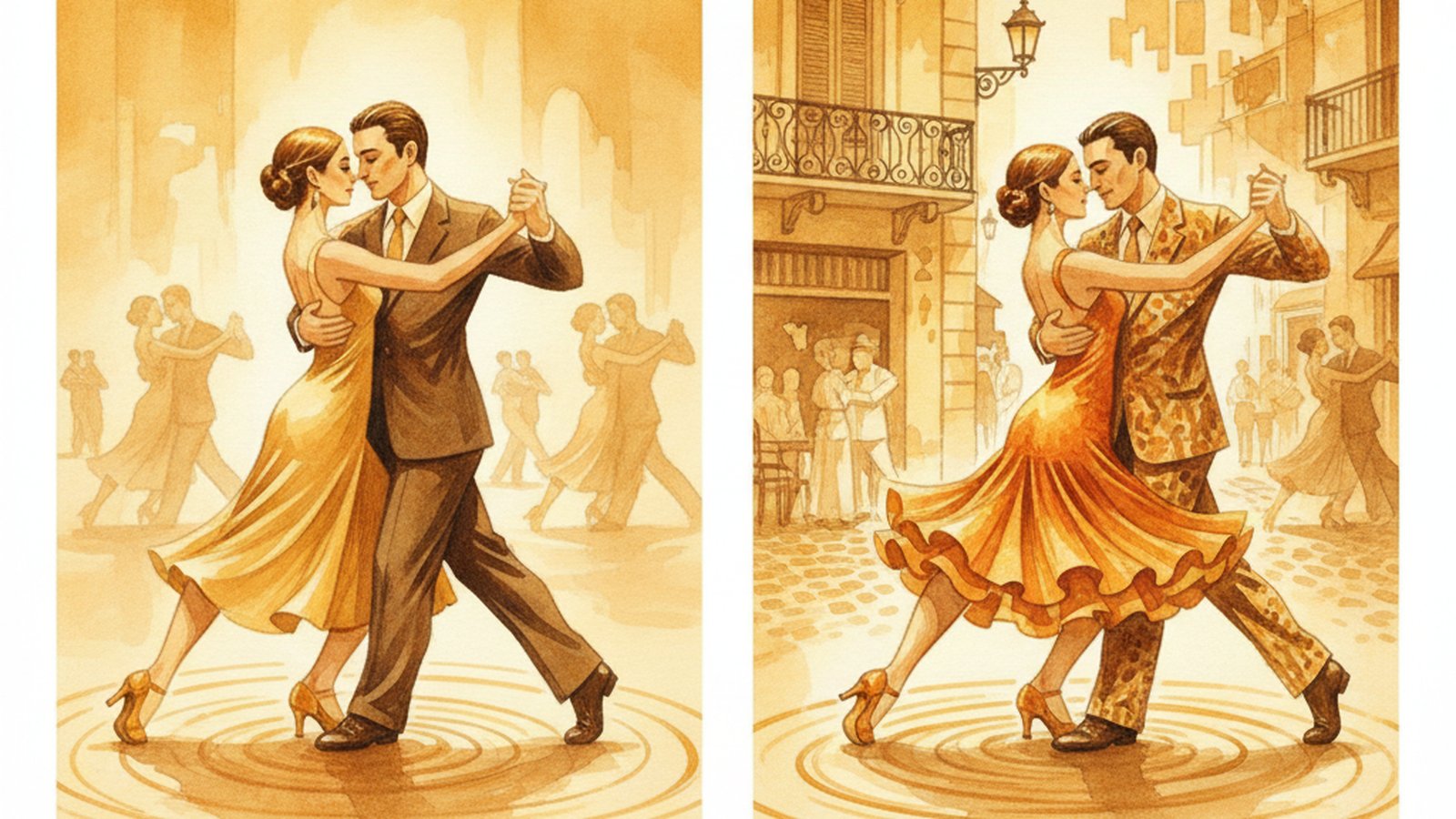
Milonga Lisa vs Con Traspié: Two Ways to Dance One Rhythm
Milonga lisa keeps it smooth; con traspié adds the cheeky syncopation. Here's how to hear, dance, and choose between both on a London floor.
How to Dance Vals With Swing and Flow, Not Just Counting
Stop counting one-two-three and start flowing. Learn the swing, timing, and musical secrets that transform your tango vals from mechanical to magical.

Tango Vals: How to Dance with Swing and Flow, Not Counting
Vals isn't one-two-three. Learn to step on beat one, add swing with optional steps, and find the continuous, circular flow that makes tango vals feel like flying.