Dissociation in Tango: Why Your Upper and Lower Body Must Disagree
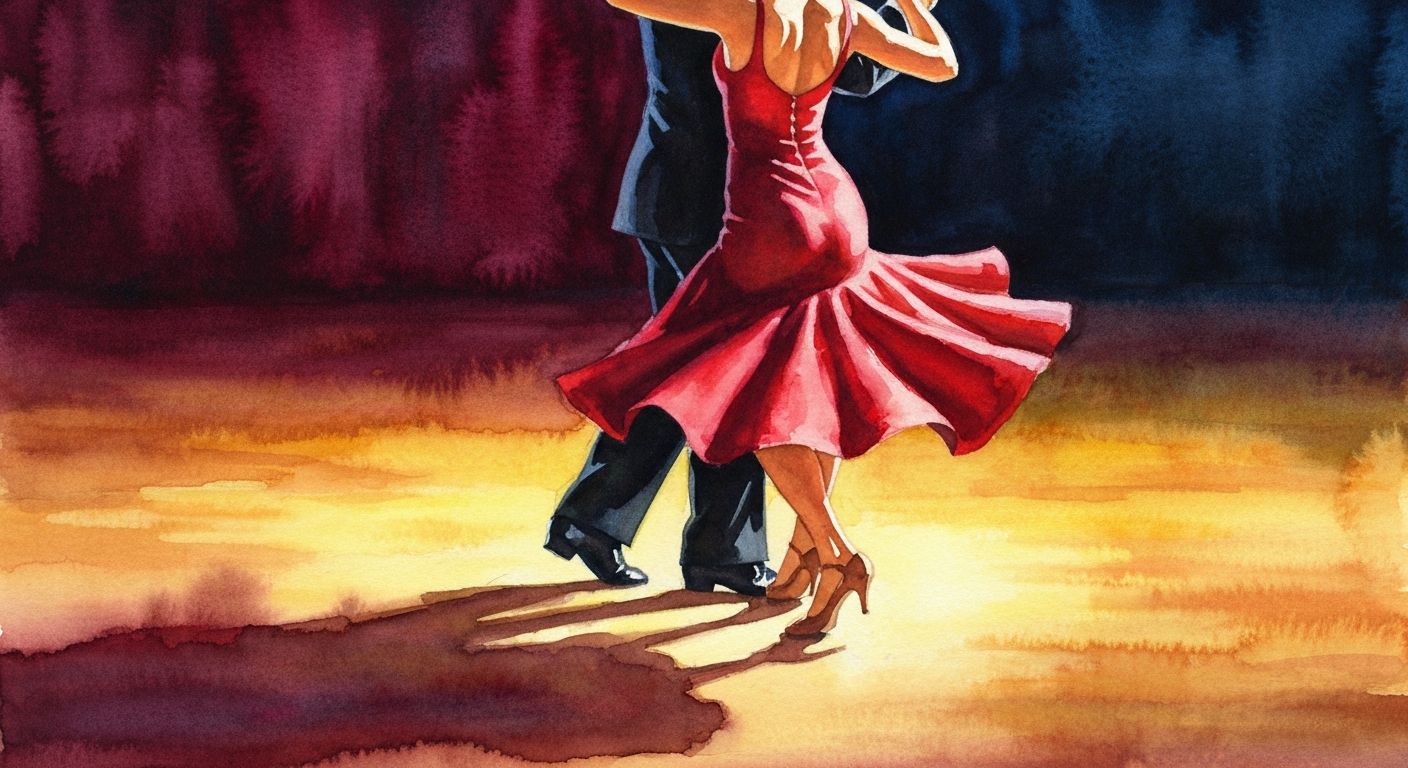
The Beautiful Contradiction at the Heart of Tango
Here's something that sounds counterintuitive: to move as one with your partner, parts of your own body need to move independently of each other. Welcome to dissociation — one of the most important and misunderstood concepts in Argentine tango.
If you've ever watched an experienced couple navigate a crowded London milonga and wondered how they make those fluid turns look so effortless, dissociation is a big part of the answer. It's the ability to rotate your upper body (torso) independently from your lower body (hips and legs), and it's what transforms mechanical steps into something that actually feels like dancing.
What Exactly Is Dissociation?
In tango, dissociation refers to the independent rotation of the upper body relative to the lower body. Imagine your torso and your hips are connected by a gentle spring. Your chest might face your partner while your legs step in a completely different direction. That twist — that controlled disagreement between top and bottom — is dissociation.
You'll also hear teachers call it disociación (the Spanish term), body twist, or sometimes contra-body movement. Whatever the name, the principle is the same: your upper body and lower body can — and should — operate on slightly different timelines and angles.
It's worth noting that dissociation isn't unique to tango. You use it every time you walk and swing your arms naturally. Tango simply asks you to refine and control what your body already knows how to do.
Why Does Dissociation Matter So Much?
Dissociation isn't just a fancy technique to show off in class. It's fundamental to how tango actually works, and here's why:
- It powers your turns. Every ocho, giro, and molinete relies on the torso leading while the legs follow. Without dissociation, turns become stiff, heavy, and off-balance.
- It maintains the embrace. In close embrace, your chest stays connected to your partner even as your feet travel. Dissociation is what makes this possible without dragging your partner along or breaking the connection.
- It creates musicality. The ability to delay your lower body's response to your upper body's intention gives you room to play with the music — to pause, to stretch a beat, to arrive at just the right moment.
- It improves your balance. A well-dissociated body moves around a stable axis. Rather than toppling into a turn, you spiral smoothly around your own centre.
Where You'll Feel It on the Dance Floor
Dissociation shows up everywhere in tango, but here are the moments where it's most visible and most essential:
Ochos (Forward and Back)
The classic ocho is essentially a dissociation exercise set to music. As the follower steps forward or backward, the torso rotates to face the leader while the hips and legs pivot in the opposite direction. For leaders, the chest initiates the invitation while the feet stay grounded. If your ochos feel clunky, the fix is almost always more — or better-timed — dissociation.
Giros and Molinetes
During turns, the leader's torso continuously faces the follower (or leads the direction of rotation) while the legs manage weight changes underneath. For the follower, the molinete steps — forward, side, back, side — require constant adjustment between where your chest points and where your feet land.
The Cross (Cruzada)
Even the humble cross involves a subtle dissociation. The leader's upper body begins to shift while the lower body creates the space that invites the follower's legs to cross.
Walking in Close Embrace
Believe it or not, even a simple walk benefits from micro-dissociation. It's what allows you to step outside your partner in a slightly open angle without losing chest contact. London milongas with packed floors reward this skill enormously.
Practical Exercises to Build Your Dissociation
The good news: dissociation is a physical skill, not a mystery. You can train it, and you'll feel improvement within weeks. Try these exercises at home or during your next practica:
1. The Standing Twist
Stand with your feet hip-width apart, knees slightly bent. Keep your hips facing forward and slowly rotate your upper body to the left, then to the right. Your belly button should stay pointing forward while your sternum turns. Start slowly and feel the gentle stretch through your core. Do this for two minutes daily.
2. Walking with Rotation
Walk forward in a straight line, but with each step, rotate your upper body to face 45 degrees away from your walking direction. Left step — torso rotates right. Right step — torso rotates left. This mimics what happens during ochos and helps your body learn the pattern.
3. Ocho Practice Against a Wall
Stand facing a wall with your palms flat against it at chest height. Now practice forward ochos — pivoting on your feet while keeping your hands (and therefore your upper body) facing the wall. The wall gives you instant feedback: if your hands slide, you're not dissociating enough.
4. The Chair Exercise
Sit on a chair with your feet flat on the floor. Without moving your legs, rotate your upper body as far as you comfortably can to each side. This isolates the twist to your torso and is a great way to build awareness of which muscles are doing the work (hint: it's your obliques and deep core).
5. Pivots with a Broomstick
Hold a broomstick across your shoulders. Practice pivoting on one foot — let the stick (your upper body) point in one direction while your hips and standing leg rotate underneath. You'll immediately see and feel how much rotation you have (or don't).
Common Mistakes and How to Fix Them
As you work on dissociation, watch out for these common traps:
- Moving only from the shoulders. Real dissociation comes from your core — the area around your solar plexus and ribcage — not from twisting your shoulders while your ribcage stays put. Think of rotating your entire chest, not just shrugging your shoulders around.
- Locking the hips. Your hips shouldn't be rigid. They need to be free to respond and follow your legs. The key is that they don't lead — they arrive after the upper body has set the direction.
- Over-dissociating. More twist isn't always better. Tango is about controlled, intentional movement. Excessive rotation breaks the embrace and throws off your axis. Aim for just enough dissociation to accomplish the movement cleanly.
- Forgetting to breathe. When concentrating on a new physical skill, people tend to hold their breath. This creates tension in exactly the muscles you need to keep supple. Breathe naturally and let your core stay engaged but not rigid.
A Note for Leaders and Followers
Both roles need dissociation, but they use it differently:
Leaders use dissociation primarily to communicate direction. Your torso tells your partner where the dance is going while your feet manage navigation and weight. The cleaner your dissociation, the clearer your lead — no arm-pushing required.
Followers use dissociation to respond with freedom. When your upper body stays connected to the leader's chest while your legs pivot and step independently, you can follow complex sequences without anticipating or losing balance. It's also what makes adornments possible — your free leg can play while your connection remains solid.
Building Dissociation Takes Time — and That's Fine
If dissociation doesn't click immediately, don't worry. It's a skill that develops gradually through consistent practice. Many dancers find it takes several months before it starts feeling natural rather than mechanical. The process often goes like this: first you understand it intellectually, then you can do it in exercises, then it shows up in your dancing when you concentrate, and finally it becomes automatic.
"The moment dissociation becomes unconscious is the moment your tango changes forever. You stop thinking about steps and start thinking about music, connection, and expression."
London has excellent practicas where you can work on technique in a low-pressure setting. Use that time intentionally — put on a tanda and focus solely on your dissociation for a few songs. The milonga will reward the effort.
Take It to the Floor
Dissociation is one of those foundations that lifts every other aspect of your tango. Better ochos, smoother turns, a more connected embrace, richer musicality — it all flows from this one principle: your upper body and lower body working in beautiful, coordinated disagreement.
Ready to put it into practice? Browse the latest milongas, practicas, and workshops on TangoLife.london and find your next chance to take these ideas from the page to the dance floor. London's tango community is waiting — and your next favourite dance might be just one good ocho away.
Related Articles
Collecting Your Feet: The Micro-Movement That Cleans Up Dance
Collection — bringing your feet together between steps — is the micro-movement that transforms messy tango into clean, elegant dance. Here's how to master it.
The Tango Vocabulary Trap: 100 Steps vs Dancing 10 Well
Knowing 100 tango steps means nothing if you cannot dance 10 well. Discover why depth beats breadth and how to escape the vocabulary trap.
Collecting Your Feet: The Tango Micro-Move That Cleans Up Your Dance
Collecting your feet — the tiny moment your ankles pass between steps — is the micro-movement that brings balance, clarity, and elegance to your whole tango.