How Korean and Japanese Fashion Reshaped Modern Tango Style
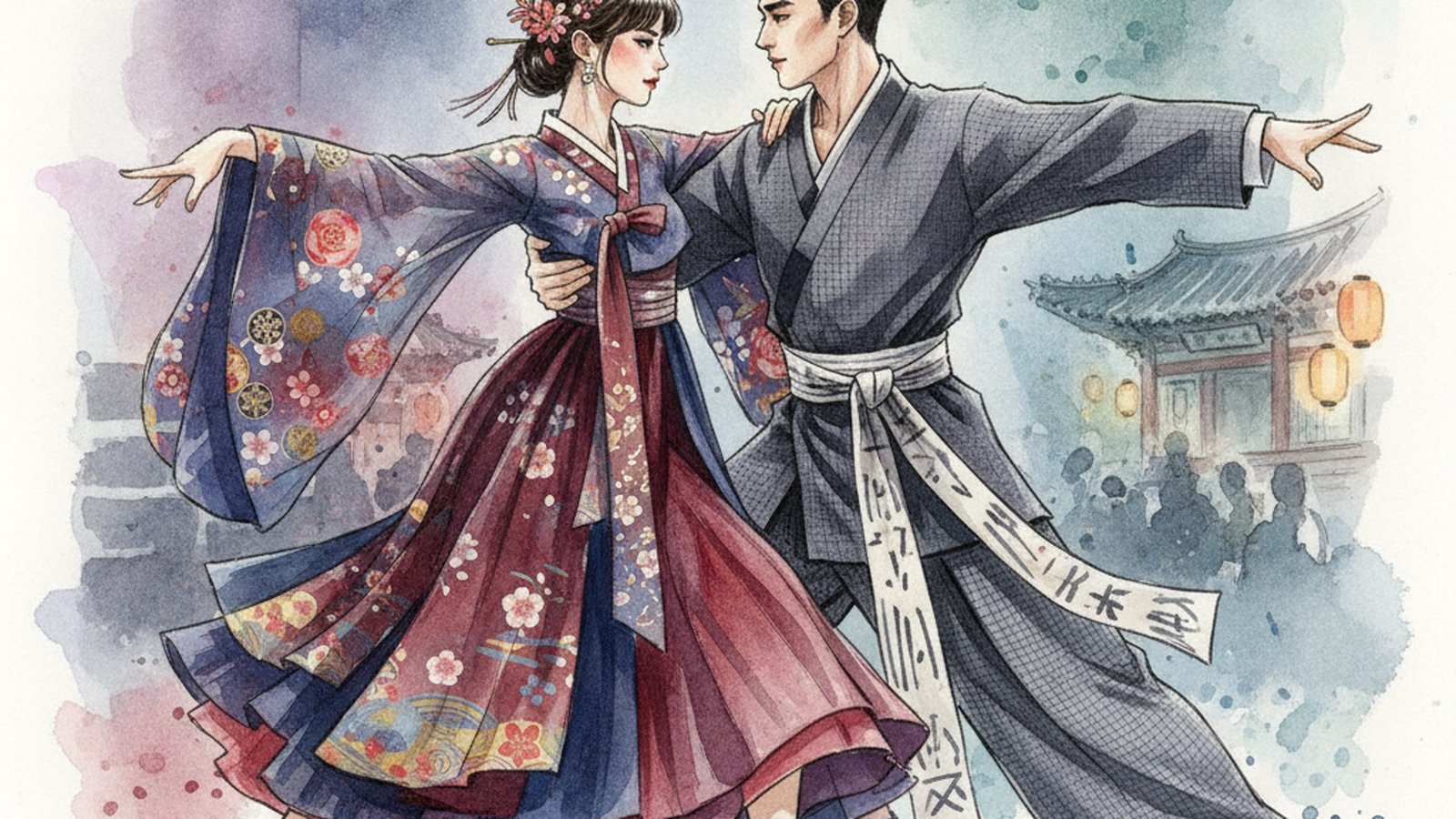
A Quiet Shift on the Dance Floor
Spend a season on the London milonga circuit and you will notice something has changed in the room. The fishtail hems and the Buenos Aires glamour are still there — they always will be — but beside them now sits something cooler and more architectural. A wide black trouser that swings like a bell. A long, boxy jacket worn over a slip dress. A top with one sleeve and one bare shoulder. A palette that travels from ivory through oatmeal to charcoal without ever raising its voice.
That look did not arrive from Argentina. It came, by a long and genuinely interesting route, from Tokyo and Seoul.
Two Tango Histories You Probably Do Not Know
Japan has been dancing tango for almost as long as Europe has. Baron Tsunayoshi Megata, a Japanese aristocrat, learned the dance in Paris in the early 1920s, returned to Tokyo, and taught it to Japanese society — famously refusing to charge for lessons. By the 1950s the singer Ranko Fujisawa was performing tango in Buenos Aires itself, and Japan had developed its own orchestras, its own recording culture and a devotion to the music that Argentine musicians have remarked on for decades.
Korea's story is younger and much faster. Seoul went from a handful of practicas to one of Asia's busiest tango cities within a couple of decades, and Korean dancers are now a familiar presence at European festivals and marathons. Crucially, that growth happened at exactly the moment Korean fashion became a global language. So when Korean dancers arrived on the international circuit, they brought a fully formed aesthetic with them — and the rest of us started borrowing it.
What Japanese Design Gave Tango
The design vocabulary of Yohji Yamamoto, Rei Kawakubo at Comme des Garçons and Issey Miyake turns out to suit tango almost suspiciously well. Consider what those designers actually argue for:
- Black as a material, not an absence. Japanese design treats black as a surface with texture, weight and sheen. Matte crepe against a slight gloss, a dry wool against a fluid viscose — the outfit reads as monochrome from across the room and as layered and considered up close. That is exactly the milonga problem solved: dim light flattens colour, so texture is what actually shows.
- Asymmetry. One shoulder, one sleeve, a hem that falls longer on the left. Tango is itself an asymmetric form — your left side and your right side do entirely different jobs in the embrace — and asymmetric cutting flatters that spiral instead of fighting it.
- Volume that moves. Anti-fit clothing does not cling to the body; it responds to it a half-beat later. A wide leg or an unstructured drape keeps travelling after your ocho has finished, which is a gift to any dancer who wants their movement read from the back of the room.
- Ma — considered emptiness. The Japanese principle of meaningful negative space is why one bold element and a lot of calm around it beats four competing ideas.
The Fabric Argument
Issey Miyake's pleating is the clearest example of Japanese design solving a practical dance problem before anyone framed it as one. Permanently pleated polyester packs into nothing, refuses to crease, breathes, and moves with the body rather than restricting it. If you dance festivals or travel to marathons, this is not a style flourish — it is luggage strategy. The same logic applies further down the price ladder: Japanese high-street engineering gave us lightweight moisture-wicking base layers and thin thermal knits that let you dress warmly for a Hackney winter without arriving at the milonga already overheating.
What Korean Fashion Gave Tango
If the Japanese contribution is silhouette and philosophy, the Korean contribution is proportion, polish and ease.
Korean styling loves a deliberate proportion game: a cropped, sharply cut jacket over a long fluid line; a high waist that lengthens the leg; sleeves that stop somewhere unexpected. For a dancer this is genuinely useful, because the eye reads the leg line before anything else, and a raised waist does more for your voleos than any embellishment.
Then there is tonal dressing — a full outfit built in three shades of the same colour family. It looks expensive, it photographs beautifully under the terrible lighting of a church hall, and it is easy to assemble from things you already own.
Korean fashion is also comfortable being genderless in a way tango has historically not been. Soft tailoring, unisex knitwear and clean sneakers-with-everything have quietly given permission to dancers who never felt served by the strict tanguera/tanguero split — and in a scene where role-swapping is increasingly normal, that permission matters.
Dress for the embrace, not for the mirror. Your partner will feel your outfit before anyone else sees it.
Shoes: Where Tokyo and Seoul Meet Buenos Aires
Argentine makers still set the standard for tango shoes, and nothing here changes that. What has changed is what dancers are asking those makers for. The influence shows up as restraint: matte finishes instead of glitter, a plain single-strap upper, black-on-black or a clean nude, and — most significantly — lower heels. The 5–6cm block heel and the well-made tango flat have gone from apologetic compromise to genuine style choice, largely because a minimalist aesthetic makes them look intentional rather than cautious.
On the practica side, the Korean influence is even more literal: a low-profile trainer with a smooth sole, worn with wide trousers, has become an entirely respectable way to turn up for two hours of technique work. Whatever you buy, judge it on the fit of the heel cup and the width of the toe box first, and the finish second. A beautiful shoe you cannot dance a full tanda in is not a beautiful shoe.
Wearing This Without Looking Like a Costume
The risk with any borrowed aesthetic is dressing as a tribute act. A few guardrails:
- Read the room first. A traditional milonga with codes still rewards elegance, so bring the minimalism in through fabric and cut rather than through streetwear. A practica will happily take the full oversized-and-sneakers proposition.
- One idea per outfit. Volume on top or volume on the bottom, not both. Asymmetry in the top or in the hem, not both.
- Nothing that assaults your partner. Stiff structured shoulders, large hardware, chunky necklaces at chin height and long loose fringe all cause problems in a close embrace. Softness is not just aesthetic here — it is courtesy.
Dressing for the London Year
London's real fashion challenge is the journey, not the dance floor. In winter, build around a long unstructured coat — the archetypal Japanese-designer silhouette — over a thin thermal base layer you can shed the moment you arrive, and simply accept that changing at the venue is normal adult behaviour. In spring and autumn, unlined tailoring and a knit that packs down small will carry you. In summer, linen and open-weave cotton beat anything synthetic; a sleeveless top with a light overshirt lets you manage both the Tube and an air-conditioned hall.
For shopping, London is unusually well served. Dover Street Market on Haymarket remains the clearest single expression of the Comme des Garçons universe. Japan House on Kensington High Street is worth a visit for the design education alone. The Japanese high-street giants on Oxford Street and Regent Street cover base layers, simple wide trousers and unfussy knitwear at sane prices. Selfridges and Liberty have both been steadily expanding their Korean designer stock, while New Malden — London's Korean quarter — is the place to go for the grooming and lifestyle side of the culture. And for actual Japanese designer pieces at survivable prices, the vintage and resale shops around Dalston, Brick Lane and Peckham are where London's better-dressed dancers quietly do their hunting.
Style Tips
- Build in texture, not colour. Milonga lighting kills colour but flatters contrast between matte and sheen — pair a dry crepe with something fluid and let the outfit do its work up close.
- Raise the waistline, lengthen the leg. A high-waisted wide trouser or a raised-waist skirt makes your leg line read from across the room, which is the single highest-return styling decision a dancer can make.
- Choose one asymmetry and commit. One shoulder, one sleeve or one uneven hem. Two competing asymmetries just read as an accident.
- Pack pleats for festivals. Permanently pleated fabric survives a suitcase, a night bus and four hours of dancing without a single crease — the most practical thing Japanese design ever handed the tango community.
- Audit your outfit by touch. Run your hand over everything you are wearing at chest and shoulder height. Anything sharp, scratchy or snaggable will be felt by every partner you dance with tonight.
Bring It to the Floor
Style in tango has never been about origin — it is about what survives contact with the embrace. Tokyo gave us a way of thinking about silhouette and stillness; Seoul gave us proportion, ease and a welcome loosening of the old rules. Both are now part of how London dances.
The only way to find your version is to go out and move in it. Browse tonight's milongas, practicas and workshops on TangoLife.london, pick a floor, and wear the thing you have been saving for a special occasion. A Tuesday practica counts as a special occasion.
Related Articles

Nuevo vs Traditional Milonga: How to Dress for Each Floor
Traditional milongas and nuevo nights ask for different clothes. Here is what to wear, which shoes to pack, and where to shop for both in London.

The Chelsea Boot, Adapted for Tango: Casual Cool That Pivots
The elastic-sided boot that Queen Victoria wore and the mods made famous is quietly brilliant for tango — once you change the sole. Here is how to choose, adapt and wear it.
How to Dress for a Tango Birthday Milonga: Celebrating in Style
The birthday vals means dancing with half the room in a row. Here is how to dress for it: fabrics, shoes, London layering and five practical style tips for celebrating properly.