Musical Storytelling: Building a Narrative Arc With Tandas
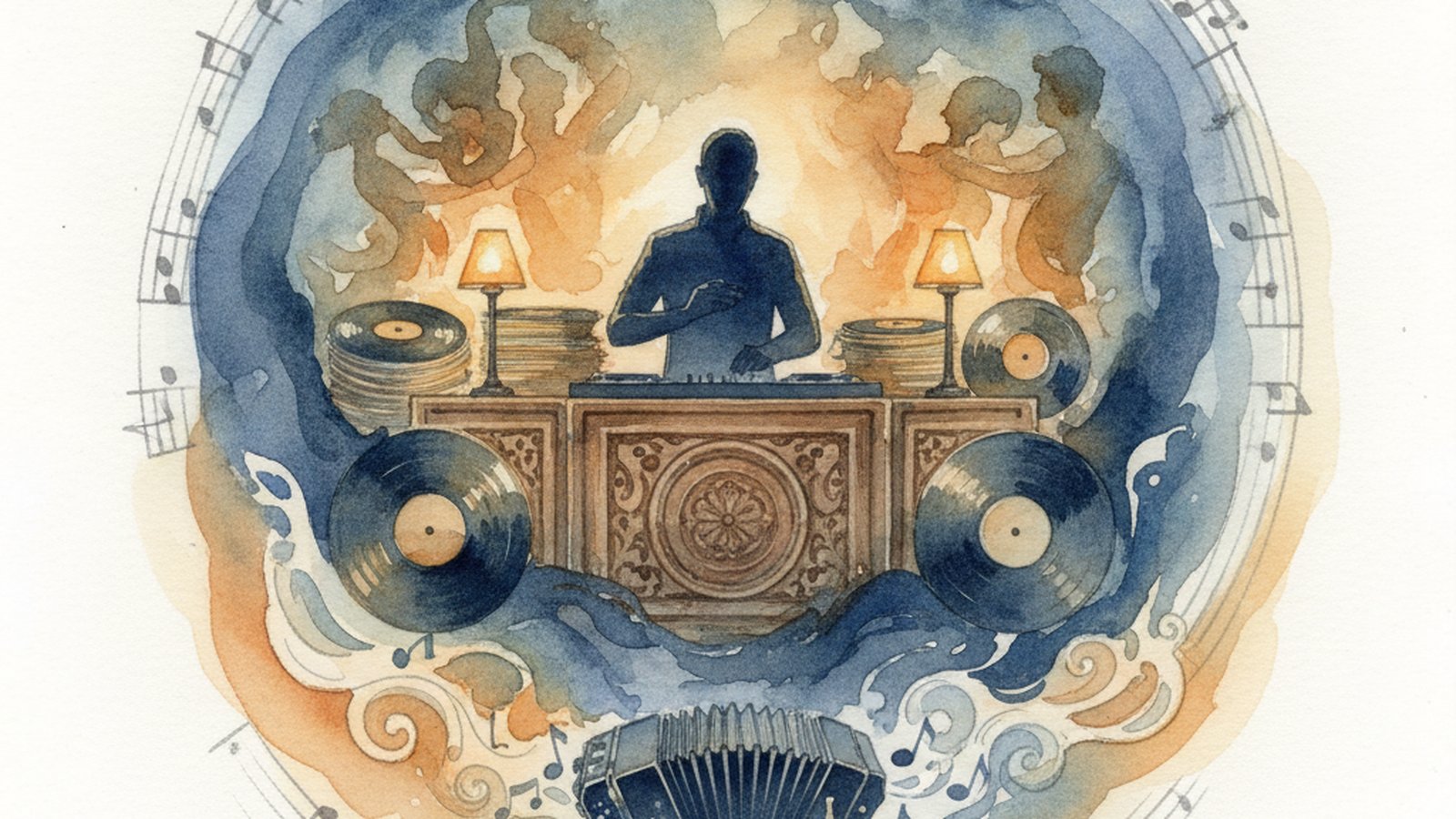
Anyone can play good tango music for four hours. A hard drive full of Golden Age transfers, a sensible rotation of orchestras, and nobody walks out. But the nights dancers actually remember — the ones they message each other about the next morning — are the nights that went somewhere. They had a beginning, a middle and an end. They made an argument and then resolved it.
That is the whole difference between a playlist and a set. A DJ who thinks in tandas is doing the job. A DJ who thinks in arcs is doing the craft.
The tanda is your sentence
A tanda is not a container for four songs you happen to like. It is a single utterance: one orchestra, one era, ideally one vocalist, one emotional register. That consistency is not pedantry. It is what allows a dancer to accept a cabeceo and commit twelve minutes of their body to a stranger without anxiety. Change the orchestra mid-tanda and you have broken the contract.
Order inside the tanda matters as much as selection. Open with the clearest statement of the idea — the track with the most legible rhythm, the one that teaches the couple how this orchestra walks. Put your most beautiful track third. End on something that lands rather than trails off, because the last thirty seconds of a tanda are what the dancers carry to the tables.
A tanda is a paragraph. The cortina is the full stop. The milonga is the essay — and like any essay, it fails if every paragraph says the same thing.
The four acts of a milonga
Act one: the invitation
The first hour is not for your best material. The floor is thin, people are still unwinding their scarves, embraces are cold and the ronda has not formed. Play clean, generous, rhythmically obvious tango: Carlos Di Sarli of the early 1940s, Ángel D'Agostino with Ángel Vargas, Francisco Canaro's mid-30s sides. Nothing that demands interpretation. You are lowering the cost of the first dance.
Act two: the rise
Once the ronda is turning, raise the pulse. This is D'Arienzo territory, Rodolfo Biagi's own orchestra, Ricardo Tanturi with Alberto Castillo. Establish your rotation now — two tangos, a vals, two tangos, a milonga is the standard London and Buenos Aires pattern — and hold it, so dancers can plan their night around it.
Act three: the summit
Somewhere between eleven and one, the room is warm, the good dancers are on the floor and the embraces have deepened. This is where Pugliese belongs, and Troilo with Fiorentino, and Miguel Caló with Raúl Berón. Pugliese is the loudest sentence in your vocabulary. Use it once. Twice at most. Three times and it stops meaning anything.
Act four: the descent
Do not end at the peak. After the summit, bring people home: warm, melodic, uncomplicated. Late Di Sarli, De Angelis, something that lets couples finish gently rather than gasping. Then La Cumparsita, and let them leave with the room intact.
Contrast is the engine
Narrative in a milonga comes from difference, not from quality. Four excellent lyrical tandas in a row will empty a floor faster than one mediocre rhythmic one, because there is no story in sameness. Work the axis deliberately:
- Rhythmic to lyrical and back. D'Arienzo, then Caló, then Tanturi. Let the dancers feel the gear change.
- Use the vals as lift. It is the breath at the top of the phrase — place it after something heavy, never after something already airborne.
- Use the milonga as release. It is the joke that breaks the tension. It also tells the room that the intensity is not going to keep climbing forever.
- Move through decades, not randomly. Drifting from 1938 to 1952 across an hour reads as development. Ping-ponging between them reads as indecision.
Cortinas: punctuation, not performance
Keep cortinas to twenty or thirty seconds, keep them firmly non-tango, and keep them consistent — one artist or one mood for the whole night. The cortina exists to clear the floor and reset the social contract. A cortina that people enjoy too much is a cortina that stops them sitting down. Fade it, do not let it end on its own; the fade is your cue that the next story is beginning.
Reading the floor
Watch feet, not faces. Faces lie; feet do not.
- Count the sitters. If more than a third of the room is seated by the second track, the tanda missed.
- Watch the ronda. A ronda that is speeding up and bunching means the music is pushing harder than the room wants. A ronda that keeps collapsing into the centre means the pulse is too vague.
- Cut to three. A tanda that is not working does not improve with a fourth track. Drop it and move on.
- Keep a rescue tanda cued. Every DJ should have one sure-thing tanda ready at all times — the one that has never failed in that room.
The room is part of the story
You can construct a perfect arc and lose it entirely to a bad PA. A few things that matter more than gear budget:
- Height and aim. Speakers at ear height on stands, placed at the corners, angled across the floor rather than into it. Sound fired at the middle of the room leaves the edges dead.
- Volume test. Dancers should be able to speak quietly in the embrace without raising their voices. If people at the tables are shouting, you are a few decibels too loud.
- Level-match your library. A 1935 shellac transfer and a 1953 recording can differ by six decibels or more. Normalise the whole collection once and never lunge for the fader mid-tanda again.
- Ease the top end. Golden Age transfers respond well to a gentle high-shelf cut and a high-pass filter around 60–80 Hz. Resist boosting bass that was never recorded.
- Sound-check twice. An empty room and a full room are different acoustic spaces — bodies absorb high frequencies. Expect to add a little brightness once the floor fills.
Recommended Tandas
Tanda 1 — The Invitation: Carlos Di Sarli with Roberto Rufino
- Corazón — Carlos Di Sarli, vocal Roberto Rufino (1939)
- En un beso la vida — Carlos Di Sarli, vocal Roberto Rufino (1940)
- Cascabelito — Carlos Di Sarli, vocal Roberto Rufino (1941)
- Zorzal — Carlos Di Sarli, vocal Roberto Rufino (1941)
Why it works as an opener: Di Sarli's pulse in this period is unmistakable and forgiving — the beat is stated plainly by the piano and the bass, so a cold floor can find it instantly. Rufino's young voice adds warmth without asking for interpretive risk. Start with Corazón for clarity, save Cascabelito for the emotional centre.
Tanda 2 — The Lift: Juan D'Arienzo, instrumental
- Hotel Victoria — Juan D'Arienzo, instrumental (1935)
- 9 de Julio — Juan D'Arienzo, instrumental (1935)
- El flete — Juan D'Arienzo, instrumental (1936)
- Retintín — Juan D'Arienzo, instrumental (1936)
Why it works as a rise: these are the sides that put Rodolfo Biagi's piano at the front of the orchestra, and the staccato drive is the most reliable floor-filler in the repertoire. Drop this after a lyrical tanda and watch the ronda tighten within eight bars. Because it is instrumental, it also cleanses the palate before you reintroduce a singer.
One last thing
Write your set down afterwards. Note what emptied the floor and what filled it, and note the time. Six months of that notebook will teach you more about narrative arc than any article can — including this one. The music has been telling these stories since the 1930s. Our only job is to put the chapters in the right order.
Ready to put it into practice? Find milongas, prácticas and festivals to DJ, dance and listen at on TangoLife.london — and go and hear how the DJs in your city are shaping their nights.
Related Articles

The Tango DJ Spectrum: From Purist to Eclectic
Purist, traditionalist or eclectic — the label matters far less than the floor. A working guide to repertoire, tanda construction, sound and reading a room, with two complete tandas.

Tango DJ Craft: Reading Body Language to Pick Your Next Tanda
The floor gives you feedback long before anyone speaks to you. How to read the ronda, the embrace and the cortina — and turn those cues into your next tanda.

Emotional Intelligence for Tango DJs: Sensing the Collective Mood
The floor never lies, but it never explains either. A practical guide to diagnosing a room's mood — and answering it with tandas, cortinas and sound that actually fit.