Packed Floor, Smaller Music: DJing a Crowded Milonga
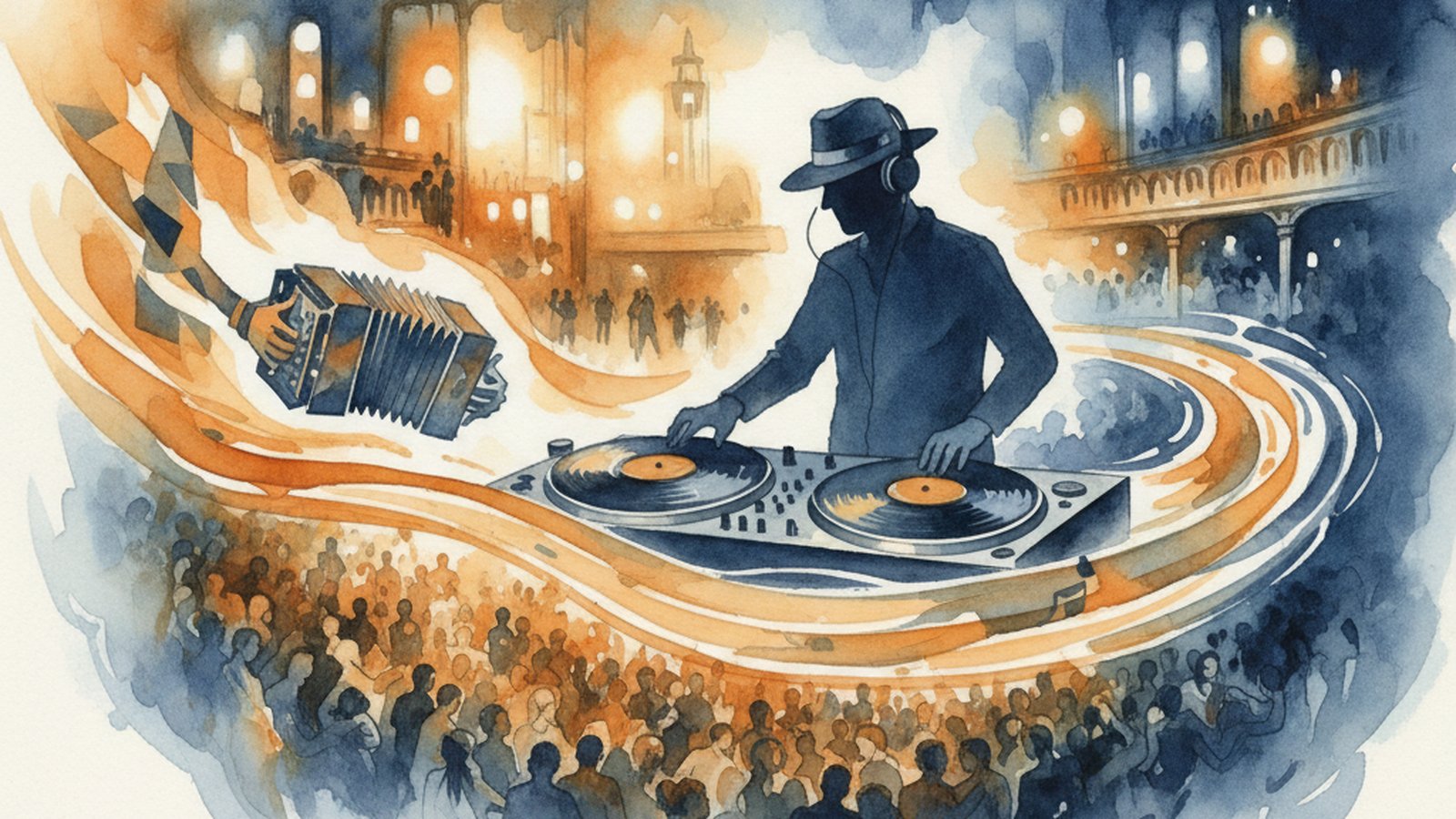
The night the room got smaller
Every milonga DJ knows the moment. Half past eleven, the class has finished, a group has arrived from across town, and the floor that held six comfortable lanes at nine o'clock is now three lanes and a scrum. Nothing about your playlist has changed, but everything about the room has. The tanda that felt generous an hour ago suddenly feels like a provocation.
Crowding is the most common condition a working DJ faces and the least discussed. We talk endlessly about energy curves and orchestra balance, and almost never about the plain fact that the same D'Arienzo tanda is a gift at forty dancers and a hazard at a hundred and twenty. Here is how I think about it, at the desk and on the floor.
What a packed room does to your sound
Before you touch a single musical decision, understand that a full room is a different acoustic space from the one you soundchecked. Bodies are excellent absorbers. The bright, ringing hall you set levels in at eight o'clock goes dry and dull once two hundred people are in it, and the high frequencies go first. At the same time the noise floor climbs: conversation at the bar, shoes, ventilation, the sheer hiss of a crowd.
Now remember what you are playing. A 1940s shellac transfer lives mostly between about 100 Hz and 6 kHz to begin with. Strip the top off that in a damp, noisy room and the marcato loses its edge. Dancers at the back stop hearing the beat clearly, and that is not a comfort issue — it is a safety issue.
A ronda is held together by a shared pulse, not by good manners. Lose the beat in the far corner and you lose the lane.
Fixes at the desk
- Raise clarity, not level. Two or three dB of gentle presence around 2–4 kHz does more for a packed room than six dB of overall volume, and it does not drive people out of the door.
- Trim below 80–100 Hz. There is almost nothing musical down there in a golden-age recording — just rumble and stage noise that turns to mud when the room is full.
- Distribute, don't blast. Two modest speakers on stands at the far end of the room, level-matched or lightly delayed, beat one loud pair behind the DJ every time. The couple in the corner should hear the same beat you do.
- Keep a meter running. Around 78–82 dB(A) at the middle of the floor is a healthy target. Past 85 people stop talking to each other, drink less, and leave earlier.
- Save your cleanest transfers for your busiest nights. Well-mastered transfers hold their transients; a soft, over-denoised rip of Nueve de julio simply dissolves into a crowded room.
Match the music's spatial demand to the space you have
Here is the whole craft in one sentence: every tanda asks the dancers for a certain amount of floor. On a busy night, your job is to ask for less.
Hold back
- Fast, driving tandas that reward travel. The 1937–39 D'Arienzo with Biagi at the piano — El flete, El irresistible — is glorious, and at high density it makes people accelerate into the couple in front.
- Rubato-heavy instrumentals. Gallo ciego, Emancipación, the great late Di Sarli instrumentals. They invite couples to stop, stage a moment, and occupy a square metre for eight bars in the middle of a moving lane.
- Anything that triggers big vocabulary. Dramatic Pugliese and most nuevo or alternative sets. Volcadas and high boleos at four couples per lane are how ankles get bruised and shoes get wrecked.
- Valses at speed. A floor full of giros needs far more room than a floor full of walking.
Reach for
- Walking tango with an unmissable pulse. D'Agostino with Vargas, Troilo with Fiorentino from 1941–43, Tanturi with Castillo, Enrique Rodríguez with Armando Moreno.
- Mid-tempo D'Arienzo with Echagüe or Mauré rather than the fastest instrumentals. The beat is still a lighthouse; the tempo is humane.
- Canaro and Donato in their steadier moods. Simple, honest, danceable by everyone — and a packed floor always contains beginners.
- Di Sarli with Rufino or Podestá at moderate density; keep the sweeping instrumentals for when the floor thins after one.
Notice the pattern. I am not asking for less energy — Tanturi with Castillo is not a low-energy tanda. I am asking for energy that lives in the beat rather than in distance covered.
Tanda construction under pressure
- Shorten to three at peak. Three-song tango tandas at the busiest hour increase turnover, give more people a dance, and cut the heat load. Nobody has ever complained to me about a three-song Tanturi.
- Order for the exit. The last track of a tanda is the mood people carry back to their seats and into the next cabeceo. If you need to calm the room, end on the calmest song, not the best one.
- Do not stack peaks. Energy multiplies with density. At capacity you need noticeably less musical intensity to reach the same room intensity.
- Lengthen the cortina slightly. Forty seconds rather than twenty-five. A full floor needs longer to empty and refill, and the cortina is your only real floor-management tool: it re-seeds the ronda from scratch, every time.
- Choose a cortina nobody dances to. On a packed night, the four couples still moving through the cortina are exactly the ones who wreck the new ronda's formation.
Reading a packed floor
Stop watching the dancers and start watching the traffic.
- Outer lane speed. It should move steadily and continuously. A stalling outer lane means you have given the room something to interpret rather than something to dance.
- The centre. If stationary couples are filling the middle, your music is asking for figures, not for a walk.
- Collisions and apologies. Count them. Three in one song is not bad floorcraft, it is the music.
- Refill time after the cortina. A floor that takes a whole song to fill is a tired, overheated floor. One that fills before the first phrase ends is hungry — feed it.
- The exits. People leaving mid-tanda is usually a heat or volume problem before it is a music problem. Tell the organiser; open a door.
The pressure valve
Milonga is your ally on a crowded night, for an unromantic reason: not everybody dances it. A milonga tanda at peak takes perhaps a third of the room off the floor, and the couples who stay share a pulse so clear that the ronda tightens up by itself. Favour milonga lisa over heavy traspié when the room is mixed in ability, and put the tanda where the density is worst rather than where your energy curve says it belongs. A gentler vals — Canaro, Donato — does a milder version of the same job.
When to leave it alone
One caveat, because everything above can be applied too zealously. A packed floor of experienced dancers is not a problem to be solved. Buenos Aires milongas run at densities that would alarm most London organisers, and they run on D'Arienzo quite happily, because the room knows how to hold a lane. The issue is never density by itself; it is the mismatch between music that demands space and a crowd that cannot provide it. Read the crowd, not the head count.
Recommended Tandas
Tanda 1 — Ángel D'Agostino / Ángel Vargas: the crowded-floor anchor
Elegant, unhurried, entirely walkable. The pulse is never in doubt, the phrases invite a pause rather than a sprint, and nothing here asks a couple for a metre of open floor.
- Como se pianta la vida — Ángel D'Agostino, vocal Ángel Vargas (1940)
- Tres esquinas — Ángel D'Agostino, vocal Ángel Vargas (1941)
- El cuarteador — Ángel D'Agostino, vocal Ángel Vargas (1941)
- Ahora no me conocés — Ángel D'Agostino, vocal Ángel Vargas (1941)
Tanda 2 — Francisco Canaro: the milonga pressure valve
Steady, sunny, and playable by the whole room. Drop this at the moment the floor is at its tightest: it thins the crowd, resets the pulse, and buys you back the space for a bigger tanda afterwards.
- Silueta porteña — Francisco Canaro, vocal Roberto Maida (1936)
- Milonga criolla — Francisco Canaro, vocal Roberto Maida (1936)
- Milonga sentimental — Francisco Canaro, vocal Ernesto Famá (1933)
The DJ's real job on a busy night
A crowded milonga is a compliment to the organiser and a test for the DJ. You cannot widen the room, so you narrow the music: shorter tandas, clearer beats, smaller spatial demands, cleaner sound. Do it well and the dancers will never know you did anything at all — they will simply say the floor felt lovely tonight. That is the review you are working for.
Want to put this into practice? Browse London milongas, practicas and festivals — and see which rooms fill and when — on TangoLife.london. Find a busy night, stand near the DJ, and watch the ronda.
Related Articles

The Tango DJ Spectrum: From Purist to Eclectic
Purist, traditionalist or eclectic — the label matters far less than the floor. A working guide to repertoire, tanda construction, sound and reading a room, with two complete tandas.

Service or Artistry? The Tango DJ's Real Job at a Milonga
Every tango DJ eventually has to choose between serving the floor and expressing a voice. A practical look at tanda construction, sound setup, reading the ronda — and why the choice is false.

The Tango DJ as Curator: Programming a Milonga Like a Gallery
A curator hangs sixty works from forty thousand; a tango DJ plays forty-five tandas from a library of thousands. Craft notes on selection, sequence, sound and reading the floor.