The A-Line Skirt for Tango: Flattering Every Figure on the Floor
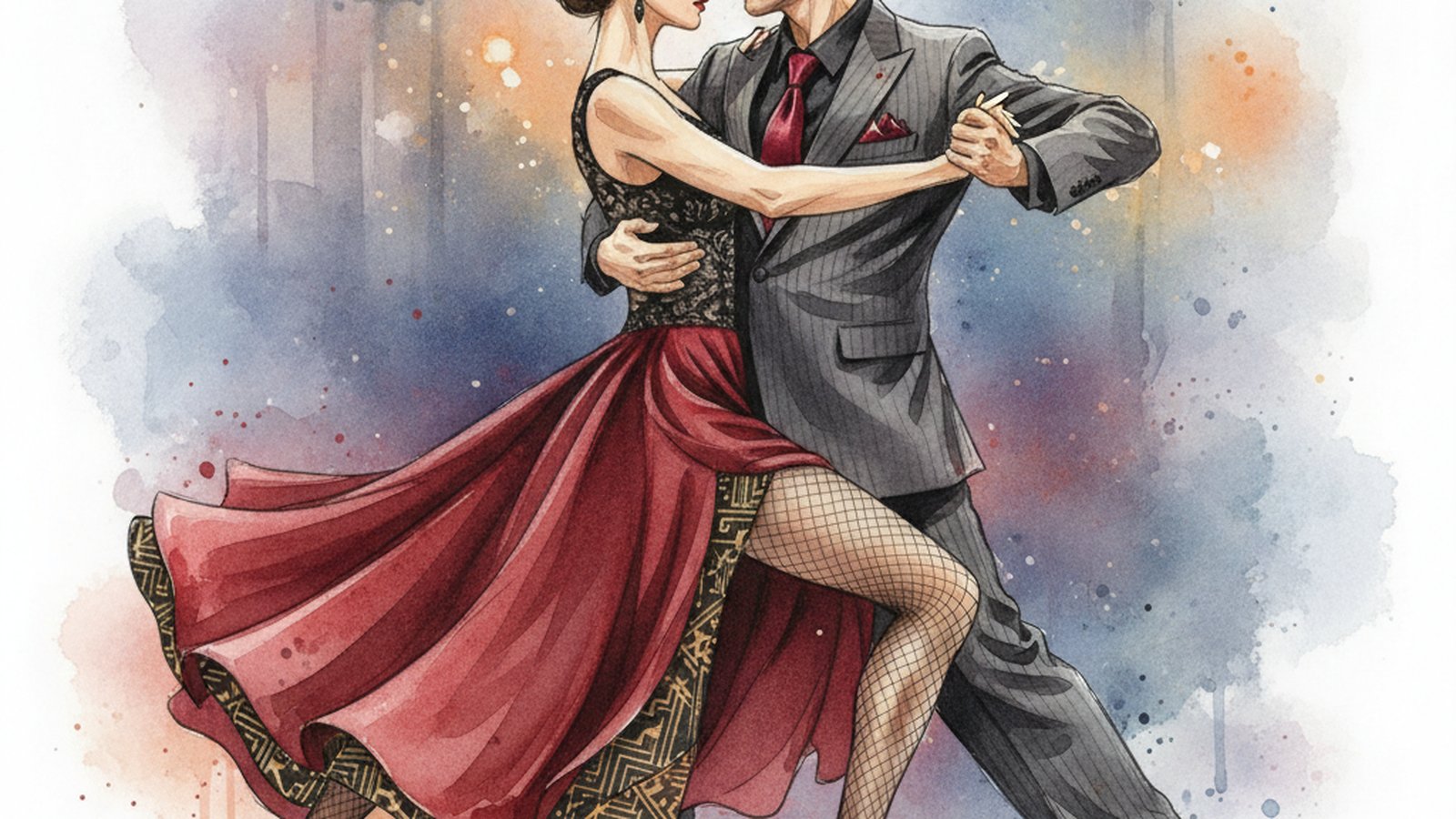
The one shape that never leaves the milonga
Walk into a London milonga on a Friday night and you will see it within thirty seconds: fitted at the waist, easing outward, ending somewhere around the knee. The A-line skirt has survived every fashion cycle since the 1950s, and in tango it has done something rarer than survive — it has become genuinely useful. It is what people reach for when they want to look considered without spending the whole night managing their clothes.
That is not an accident. Tango asks strange things of a garment. It wants a silhouette that reads clearly across a dim room, a hem that moves the instant the leg moves and settles the instant it stops, and a waistband that survives three hours of a partner's hand resting on it. The A-line answers all three, which is why you find it on beginners at their first practica and on professionals in the demo.
A short history: Dior's letter, Buenos Aires' floor
The name comes from Christian Dior, who showed his A-line collection in spring 1955 — narrow at the shoulder, widening toward the hem, the outline of a capital A. It was part of a run of alphabet silhouettes he built in the 1950s, and it is the only one most of us could still draw from memory.
Tango arrived at the same shape from the other direction, and earlier. In the Golden Age of the 1940s, women went to the milonga in the good version of what they wore to work: tailored, below the knee, sleeves, stockings. Nobody was dressing for a camera. They were dressing for a crowded floor and a long tram ride home. The skirts that survived those nights were the ones that let you pivot. When social tango returned to Europe in the wake of the Tango Argentino stage shows of the 1980s, the wardrobe travelled with the music, and the A-line quietly became the default.
A tango skirt has one job description: disappear while you are dancing, and be beautiful in the half-second after you stop.
The anatomy of a good tango A-line
Length
Just below the knee is the workhorse: elegant, unfussy, works with any heel height. Mid-calf reads romantic and suits slow salon dancing beautifully. Above the knee belongs to practicas and hot rooms, and wants dance shorts underneath so you never have to think about it again.
The measurement that matters most is not the hem number, though — it is whether the hem clears your ankle. Tango is legible at the feet. A skirt that swallows the ankle bone hides the exact place where the dance happens.
Fabric and drape
Weight is everything. You want a fabric with enough body to swing out and enough sense to come back: wool crepe, ponte, a heavier viscose, tencel twill, a good bias-cut rayon. Stiff cotton poplin holds its shape but refuses to move and creases the moment you sit down. The very lightest chiffons behave like a rumour unless they are lined and the hem is weighted.
The changing-room test takes four seconds. Hold the waistband, pivot sharply on the ball of one foot, and stop. A good tango skirt flares and returns. A bad one either never moved, or is still moving.
The waistband
Go high. A waistband sitting at your narrowest point lengthens the leg line, and — more practically — it puts the seam above where a leader's hand rests on your back. Choose a wide, softly constructed band over a rigid contour band that digs in when you fold forward into the embrace. An elastic-backed waistband is not a compromise in tango; it is an upgrade.
Hardware and small details
Side zip beats centre-back zip: a metal pull under someone's palm is uncomfortable for both of you. Skip patch pockets, which break the line, catch fingers and press your phone into a hip bone. Watch for linings that cling to tights — silk or cupro lining, a slip, or an anti-static spray solves an evening of quiet fidgeting. Chunky belt loops and buckles: no.
Flattering every figure — what that actually means
The A-line is the closest thing clothing has to a universal silhouette because of one structural trick: it is fitted at the smallest point and skims everything else. It does not require you to be a particular shape. It requires only a waist, and every body has one somewhere.
What changes between bodies is the adjustment, not the verdict:
- If you are fuller through the hip, choose a steeper flare that begins at the widest part rather than above it — a skirt that starts flaring at the hip bone and then meets your widest point mid-flare will pull and ride.
- If you are straight through the middle, a contrast waistband, a yoke or a visible seam creates the definition the fabric will then hang from.
- If you are petite, keep the hem just under the knee and match your tights to your shoes to avoid chopping the leg into segments.
- If you are tall, take the length you actually want. Midi is yours.
- If you are curvy, look for a proper lining and a hem circumference generous enough that the skirt never has to stretch to let you walk.
And let us be honest about the word flattering. On a dance floor, the most flattering thing in the room is a person who has stopped thinking about their clothes.
The hem is a frame for your shoes
Hem length and heel height are one decision, not two. Adding six or seven centimetres under your heel changes where the hem lands on the calf and changes the whole line. Always try a skirt on in your dancing shoes, or at least in a heel of the same height, and look at the mirror from the side as well as the front.
Colour does real work down there. A shoe that contrasts with the hem makes every step and pivot visible from across the room. A shoe matched to your tights lengthens the leg into one clean column. Both are good; they are simply different sentences.
Reading the room: practica, milonga, festival
London is a forgiving tango city. There is no printed dress code anywhere, but there is a temperature to each room, and reading it is part of the pleasure.
- Practica: a dark jersey A-line and a decent t-shirt. Comfort wins. Nobody is looking.
- Regular milonga: dress as you would for a good restaurant. This is where the A-line earns its keep — a wool or crepe skirt, a fitted top, the shoes you can actually dance in.
- Gala, festival or marathon night: go up a register. Better fabric, a bolder colour, a hem that catches the light. Keep the shape, raise the material.
Dressing for a London year
Winter means wool blends and ponte, opaque tights, and the small local hazard that tights grip lining. Travel in trousers, carry the skirt, change at the venue. Everyone else is doing the same thing behind the same door.
Summer means outdoor milongas, warm halls and lighter cloth. Pure linen creases into a map of your evening within one tanda — a linen-viscose mix behaves far better. Line the skirt, or weight the hem, so that an enthusiastic boleo does not become a news event.
Where to look in London
You will rarely find a tango skirt sold as a tango skirt here, which is fine, because you are really shopping for a shape.
- Goldhawk Road, Shepherd's Bush — the fabric strip. An A-line is one of the simplest patterns there is; a metre and a half of good crepe and a dressmaker will beat almost anything on the high street.
- Vintage: Brick Lane, Portobello Road and Camden turn up 1950s and 1990s A-lines constantly, and the older ones are usually better made.
- Charity shops in the wealthier postcodes — Marylebone, Chelsea, Primrose Hill — for wool skirts at a fraction of what they cost new.
- A tailor. The most underrated address in tango. Shortening a hem or taking in a waist costs very little and turns an almost-right skirt into your favourite one.
- Shoes: the Buenos Aires makers still set the standard, and most Londoners buy them online or at the trunk sales that travel with festivals and marathons. For a first proper heel with a suede sole, the dancewear shops around Covent Garden are worth a visit — check current opening hours before you make the trip.
Style Tips
- Do the pivot test before you buy. In the changing room, turn sharply on the ball of one foot, then sit down and cross your legs. If the skirt twists on your waist or rides up, it will do that all night.
- Wear dance shorts underneath, always. They cost almost nothing, and they buy you the freedom to stop thinking about your hem entirely.
- Put the zip on the side. Nothing at centre-back — no zip pull, no buttons, no bow. That is where a hand goes.
- Match hem length to heel height as one decision. Try every skirt on in your dancing shoes, and check the side profile in the mirror, not just the front.
- Pack a change of top, not a change of skirt. A matte-fabric A-line will look composed after three hours; the top is what needs rescuing at the break. Add a spare pair of tights and go easy on perfume — you dance cheek to cheek.
See you on the floor
A skirt is only ever half of the equation. The other half is a room with good music, a floor with room to walk, and people who are pleased to see you. If you have a new A-line hanging up and nowhere to wear it yet, find a milonga, practica or class near you on TangoLife.london — browse what is on this week across London and beyond, and go and let that hem do what it was cut to do.
Related Articles

How to Choose the Right Bra for Tango: Support and Discretion
Straps that slide, bands that ride up, clasps your partner keeps finding. A practical guide to choosing a bra that gives real support and stays invisible through a five-hour milonga.

Nuevo vs Traditional Milonga: How to Dress for Each Floor
Traditional milongas and nuevo nights ask for different clothes. Here is what to wear, which shoes to pack, and where to shop for both in London.

Turkish Tango Shoes: Atlas, Tangoman and the Eurasian Road
Istanbul has quietly become one of tango’s great shoemaking cities. A look at Atlas, Tangoman and Turkish construction — plus how to size, order and import a pair to London.