How Immigration Shaped Tango: The Buenos Aires Story
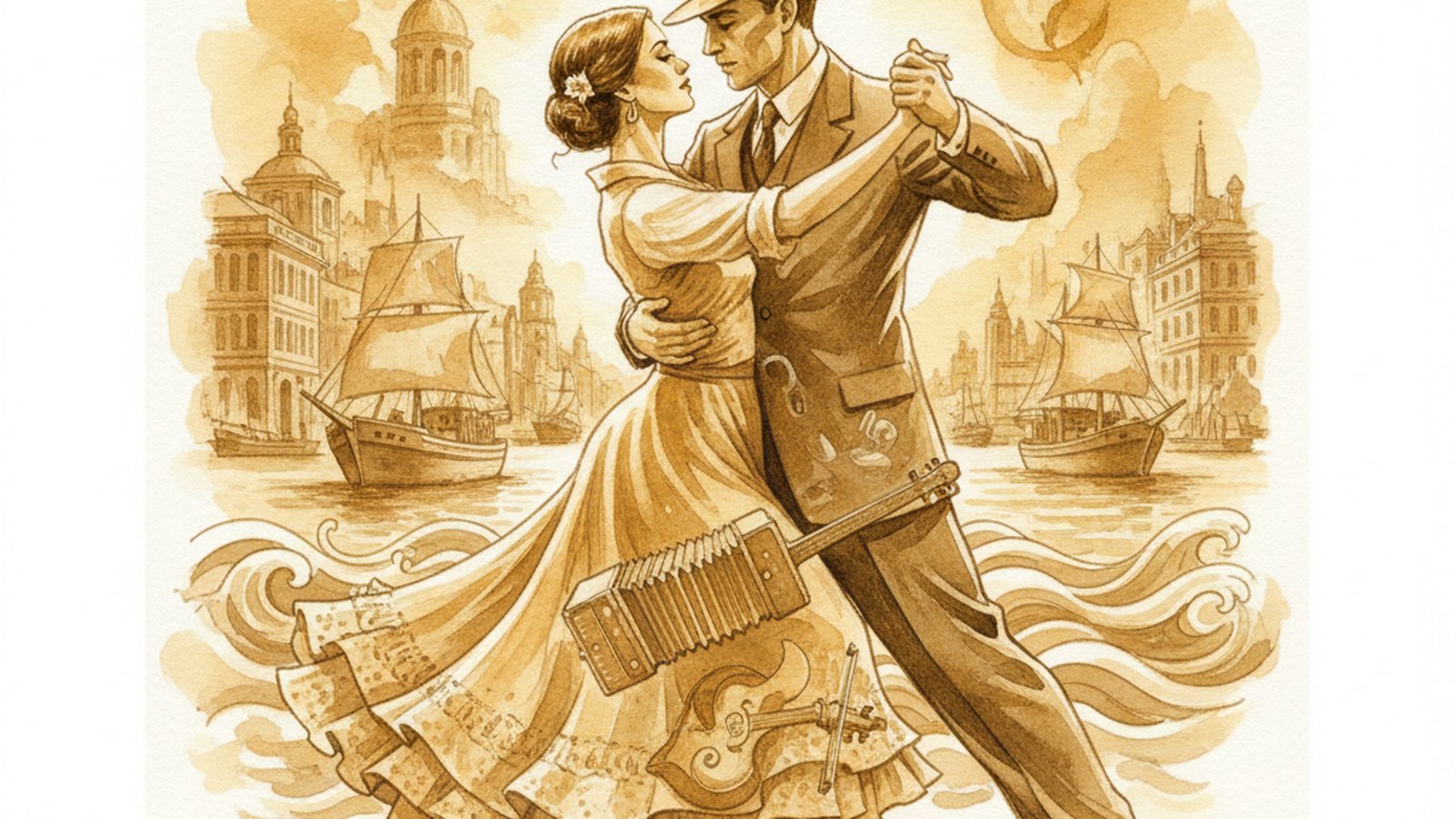
A city where almost everyone had just arrived
Between 1870 and 1930, roughly six million people stepped off ships onto the docks of Buenos Aires. About half of them stayed. By the census of 1914, close to half the population of the city had been born somewhere else — overwhelmingly Italy and Spain, but also Poland, Russia, Germany, France, Syria and the Ottoman lands. The port grew faster than the city could house it. Whole neighbourhoods went up around the water for people who had no idea yet whether they were staying a year or a lifetime.
Tango was born in that churn. Not as a folk dance passed down through generations in a village, but as something invented on the spot by people who had left their generations behind — and who badly needed a way to communicate with strangers.
The conventillo: a dance floor made of neighbours
Most new arrivals landed in the conventillos — old townhouses in San Telmo and La Boca carved into single rooms around a shared courtyard. A Neapolitan family on one side, Galicians opposite, a Polish tailor upstairs, an Afro-Argentine family who had been in the city for generations at the end of the corridor. One tap, one patio, four or five languages and nobody with the authority to insist on any of them.
That patio is where tango learned its manners. You cannot rehearse a choreography with a partner you met ten minutes ago whose Spanish is worse than yours. You need a vocabulary that can be picked up by watching, and improvised in the moment, and understood through the body rather than the ear. Which is to say: you need a lead and a follow, a shared embrace, and a set of unspoken rules about the floor.
Anyone who has walked alone into a milonga in an unfamiliar city already knows this feeling from the inside.
What each wave brought with it
Tango is often described as a fusion, which makes it sound tidier than it was. It was more like a long argument between musical traditions that happened to end up in the same courtyard.
- From Germany, the bandoneón. Developed around the 1840s and associated with Heinrich Band of Krefeld, it was reportedly intended as a portable substitute for a church organ in places that could not afford one. It arrived in the Río de la Plata on merchant ships and was promptly put to work in brothels, cafés and tenement patios. The wrong instrument in the right place — and the sound of tango ever since.
- From Italy, the singing line. Southern Italian song and the habits of the opera house gave tango its long, aching melodic phrases. Listen to Di Sarli or Fresedo and you can hear a violin trying to be a tenor.
- From Spain and Cuba, the rhythm underneath. The habanera pattern travelled from Havana to Andalusia and back across the Atlantic, arriving with Spanish theatre companies and sailors.
- From Africa and the Río de la Plata’s Black communities, the pulse. Candombe drumming shaped the early feel of the music, and the word tango itself most likely came from those communities. It is the part of the story most often written out of the polite version, and the part that holds the whole thing up.
- From the pampas, the milonga. The payadores, guitar-playing improvising singers of the countryside, brought their fast, teasing songs into the city as rural workers migrated in.
- From central Europe, the waltz, polka and mazurka — which is precisely why we still dance vals and why it turns anticlockwise like a ballroom.
A language nobody’s parents spoke
The same collision produced lunfardo, the slang of the port and the prison yard, built largely from Italian dialects. If you have ever wondered why tango lyrics resist the dictionary, this is why. Laburar, to work, comes straight from lavorare. Fiaca, that heavy Sunday-afternoon laziness, from fiacca. Morfar, to eat, from Italian street slang.
Then there is vesre, the habit of flipping syllables: gotán for tango, feca for café. A private code invented by people who were newly, awkwardly public. Alongside it ran cocoliche, the half-Italian half-Spanish speech of the first generation, mocked on stage and then quietly absorbed into how the city actually talked.
Homesickness became a genre
Once tango found words, it mostly used them to describe being far from home. Anclao en París is a man stranded in Europe, aching for a Buenos Aires street corner. Mi Buenos Aires querido was written and filmed abroad. Astor Piazzolla — grandson of Italian immigrants, raised partly in New York — wrote Adiós Nonino for his father, on tour, unable to get home for the funeral.
Even Carlos Gardel, the face of the whole art form, was an immigrant: born in Toulouse in 1890 and carried to Buenos Aires as a toddler by his mother. The most Argentine voice of the twentieth century arrived by boat.
Enrique Santos Discépolo, himself the son of an Italian immigrant, called tango a sad thought that is danced. It is a definition written by someone whose family knew exactly what had been left behind.
Look at the names on the orchestras and the pattern is unmistakable: D’Arienzo, Di Sarli, Pugliese, Troilo, De Caro. The golden age was largely made by the children of people who had stepped off those ships a generation earlier.
Tango emigrated too — and it came here
The story does not end at the docks of Buenos Aires. Around 1912 tango reached Paris, was declared scandalous and then fashionable, and that Parisian approval was what finally made it respectable back home. Within a year it had crossed the Channel. By 1913 London hotels were hosting tango teas, with the Waldorf in Aldwych among the best known — afternoon dancing for a city that had decided this was the thing to be seen doing.
So London’s relationship with tango is now well over a century old. And our scene has kept the original character of the music. Walk into a practica in Hackney or a milonga in Camden and you will hear Italian, Spanish, Polish, Turkish, Japanese, Portuguese and Romanian before the first tanda ends. We are, quite literally, dancing an immigrant art form in a room full of immigrants. The conventillo patio, relocated to a church hall with a decent floor.
What to do with this on a Tuesday night
- Listen for the bandoneón as a lung. It opens and closes, it breathes, it runs out of air. Once you dance to the breath rather than the beat, your pauses stop feeling like mistakes.
- Learn five words of lunfardo. Not to show off — just so the lyrics stop being wallpaper. A single understood line changes how you hear a whole tanda.
- Compare two orchestras in one evening. D’Arienzo, all insistent rhythm, against Di Sarli, all long singing line. Two different inheritances of the same city.
- Dance with someone whose first language is not yours. The cabeceo exists precisely because tango was built by people who could not rely on small talk. It still works better than words.
- Ask people where they learned. At any London practica you will collect a map of the world in about twenty minutes. That is not a side effect of the scene. That is the scene doing what tango has always done.
The next time you are standing at the edge of a floor in a room where you know two people, remember that this is the original condition of the dance. Tango was invented by strangers, for strangers, in a city where nobody could assume anybody shared their past. It was designed for exactly the situation you are in.
Come and stand at the edge of a floor
London has milongas, practicas, classes and festivals running almost every night of the week, from beginner-friendly rooms where nobody minds a wobble to late-night traditional milongas where the ronda moves like clockwork.
Find what is on this week at TangoLife.london — browse by night, by neighbourhood or by level, and pick one you have never been to. Somebody else there is arriving for the first time as well.
Related Articles

The Conventillo: How a Shared Patio Gave Birth to Tango
Tango did not begin in a ballroom. It began in the shared courtyard of a Buenos Aires tenement — and the habits that patio taught still explain how we dance in London halls tonight.

The 1980s Tango Revival: How a Dying Dance Came Back
By the late 1970s Argentine tango was down to a handful of milongas and a missing generation. Here is how a Paris theatre run and a few old milongueros brought it roaring back.
Tango Books for Dancers: Reading That Deepens Your Understanding
The best tango books add depth to your dancing through cultural context, emotional insight, and musical understanding. Here are the essential reads.