Tango's African Roots: The Rhythm Under Every Milonga
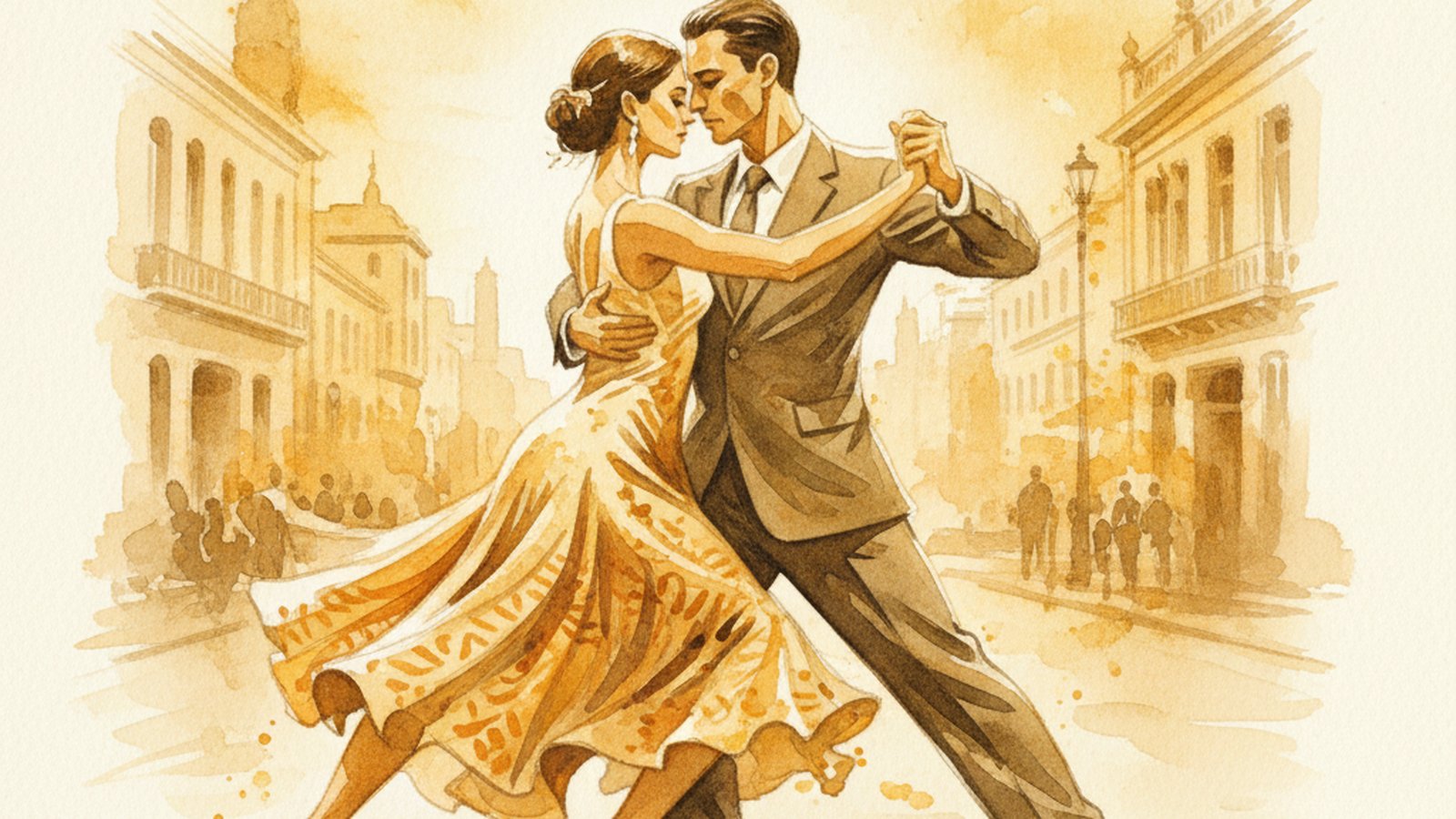
There is a moment that happens at almost every London milonga. The DJ drops a milonga tanda — Milonga sentimental, perhaps, or something with a bit more swagger — and the room changes. Walking couples start bouncing. Shoulders loosen. Someone who was very correct and very upright three minutes ago is suddenly doing something with their hips that they would firmly deny on Monday morning.
That shift is not just a change of tempo. It is the sound of Africa arriving in the room, roughly two centuries after it first reached the River Plate.
Before it was a music, tango was a place
Most dancers assume tango is simply the name of the dance. But in Buenos Aires and Montevideo in the early 1800s, the word had an address. It meant the yard, the shed, the drum house where enslaved and free Africans gathered on Sundays to play, sing and dance. Colonial authorities wrote it into ordinances, restricting where the tangos could be held and how late the drums could carry. The word travelled from the place, to the sound made in that place, and only much later to the couple dance we recognise.
Where the word itself originally came from is still argued over. One camp traces it to Kikongo and neighbouring Niger–Congo languages, where roots around tanga carry senses of dancing to the drum. Another points to Spanish and Latin. Honest answer: nobody has closed the case. What is not in dispute is that the earliest documented tangos in the Río de la Plata were Black gatherings.
Milonga has a cleaner trail. It comes almost certainly from Kimbundu, an Angolan language, as the plural of mulonga — words. It survives in Argentine Spanish meaning words, talk, a tangle, an argument. Every time you say you are off to a milonga on Friday, you are speaking a little Kimbundu.
Buenos Aires was a Black city
This is the part that surprises people. In the late colonial censuses, close to a third of the population of Buenos Aires was of African descent. Whole barrios — Monserrat, San Telmo — were centres of Afro-porteño life, with mutual aid societies, carnival groups and drumming traditions collectively known as candombe.
By the 1880s the official figures had collapsed to a couple of percent. Not because the community vanished, but because of a brutal combination: conscription into the independence wars and then the Paraguayan War, the yellow fever epidemic of 1871 that tore through exactly those low-lying southern neighbourhoods, intermarriage, and then a tidal wave of European immigration alongside census categories that quietly reclassified people out of existence. Afro-Argentines were decimated, diluted, and then edited out of the national story.
The music did not leave with them.
The drum that got inside the instruments
The clearest inheritance is rhythmic. Underneath milonga — and under a great deal of early tango — sits a short rhythmic cell often called the habanera, built on the tresillo: eight quick pulses grouped 3-3-2. Count it out loud: ONE two three FOUR five SIX seven eight. That lopsided grouping is one of the most widely travelled rhythmic ideas on earth, carried out of West and Central Africa and reassembled across the Americas — in Cuban son, in Brazilian samba, in New Orleans, and in the Río de la Plata.
It reached Buenos Aires partly through the Cuban contradanza and partly through the candombe already being played a few streets away, and it fused with the rural milonga campera of the payadores. That fusion is the engine room of early tango.
Then the drums thinned out — banned, discouraged, and eventually without enough players to sustain them — and something remarkable happened. The rhythm migrated into the instruments. You can hear it in the percussive slap of the guitar, in the double bass, in the left-hand marcato of the bandoneón, in the low octaves of the piano. Osvaldo Pugliese's famous yumba — that heavy, dragging accent that makes a whole floor lean — is a drum stroke played by an orchestra with no drums in it.
The drums did not disappear from tango. They moved indoors, into the left hand of the bandoneón and the underside of the piano.
What your body is already doing
The dance inheritance is subtler, and worth stating carefully: candombe is not a partner dance, so nobody handed tango a set of figures. What crossed over was something more fundamental — a way of holding the body and relating to a pulse.
Nineteenth-century observers described the corte and the quebrada — the cut, the break in the walk, the bend and twist through the hip — in Black dance in Buenos Aires before those words attached themselves to tango, and were scandalised by both. The soft knee, the low centre, the weight sitting a fraction behind the beat rather than punctually on top of it, the whole architecture of two people improvising over a shared groove rather than reciting a sequence: that logic is far closer to Afro-diasporic social dance than to European ballroom.
It is loudest in canyengue, the earliest surviving style — bent knees, offset embrace, a walk that swings rather than glides. Even the name is thought to come from Kikongo, carrying a sense of melting into the rhythm.
The names worth knowing
Afro-Argentine musicians were not background figures in tango's birth. They were authors.
- Rosendo Mendizábal, pianist, wrote El entrerriano in 1897 — one of the first tangos published under a named composer, and still played by orchestras today.
- Casimiro Alcorta, a violinist known as el negro Casimiro, is credited with the melody that was later cleaned up and published as Cara sucia.
- Carlos Posadas, violinist and composer, worked at the heart of the Guardia Vieja.
- Enrique Maciel, guitarist and bandoneonist, co-wrote La pulpera de Santa Lucía, a vals that has probably made you close your eyes at some point.
Attributions from the 1890s are genuinely murky — much of what we know arrived through memoirists writing decades later, and scholars still argue about the details. But the pattern is unmistakable, and so is the erasure that followed it.
A listening week for London dancers
The best way to feel any of this is with headphones on the Northern line rather than in an argument about etymology. Try this sequence:
- A candombe recording from Montevideo — listen for the three drums, the chico, repique and piano, locking into one another.
- Immediately after, a Canaro or Típica Victor milonga. The relationship announces itself.
- Azabache (Miguel Caló, 1942) — a tango written explicitly in candombe colours.
- La Yumba and Negracha (Pugliese). If you have ever danced at, or heard old hands reminisce about, the London milonga named Negracha, that is where the name comes from.
- Anything by Horacio Salgán, who had Afro-Argentine ancestry and never lost the percussive attack in his piano.
- Juan Carlos Cáceres, Tango Negro — a modern Argentine musician who spent a career pulling this history back into the light.
Taking it onto the floor
- Stop marching in milonga. Let the 3-3-2 do the work: long, long, short. The music is already syncopated, so you do not have to add anything clever.
- Treat the traspié as grammar, not decoration. It is the syncopation of that cell made visible in the feet.
- Drop your centre a couple of centimetres and let the knee stay soft. The bounce lives in the joints, not in the shoulders.
- Followers: the offbeat lives in the free leg. Resist the urge to tidy it away.
- Ask your DJ. Most London tango DJs have candombe-flavoured tandas they rarely get to play. They will be delighted you asked.
- Book a canyengue workshop when a teacher passes through. One afternoon of it will change how you walk in a normal tango.
London is an unusually good place to do this. This is a city where you can hear West African drumming on a Saturday afternoon, dance a milonga on Saturday night, and find the same rhythmic ancestor in both. Knowing the history will not make you a better dancer on its own — but it does make the music louder, and it gives credit where a great deal of it is owed.
Come and feel it in person. Browse this week's classes, practicas and milongas across the city on TangoLife.london, find a milonga tanda that makes your knees bend, and let two hundred years of rhythm do the rest.
Related Articles
La Cumparsita: The Story Behind Tango's Most Famous Song
La Cumparsita is the most famous tango ever written and the traditional closing song at milongas worldwide. Discover the fascinating story behind it.

Tango's Journey to Paris: How Europe Fell for the Dance
How a Buenos Aires street dance conquered Paris in 1913, sparked a tango craze in London's West End, and came home respectable — and what that history means for the way we dance today.
How Immigration Shaped Tango: The Buenos Aires Story
Tango was invented by strangers, for strangers, in a Buenos Aires where half the city was foreign-born. Here is how Italian, Spanish, German and African arrivals built the dance we do in London.