Tango and Creativity: How Improvising on the Floor Unlocks Ideas
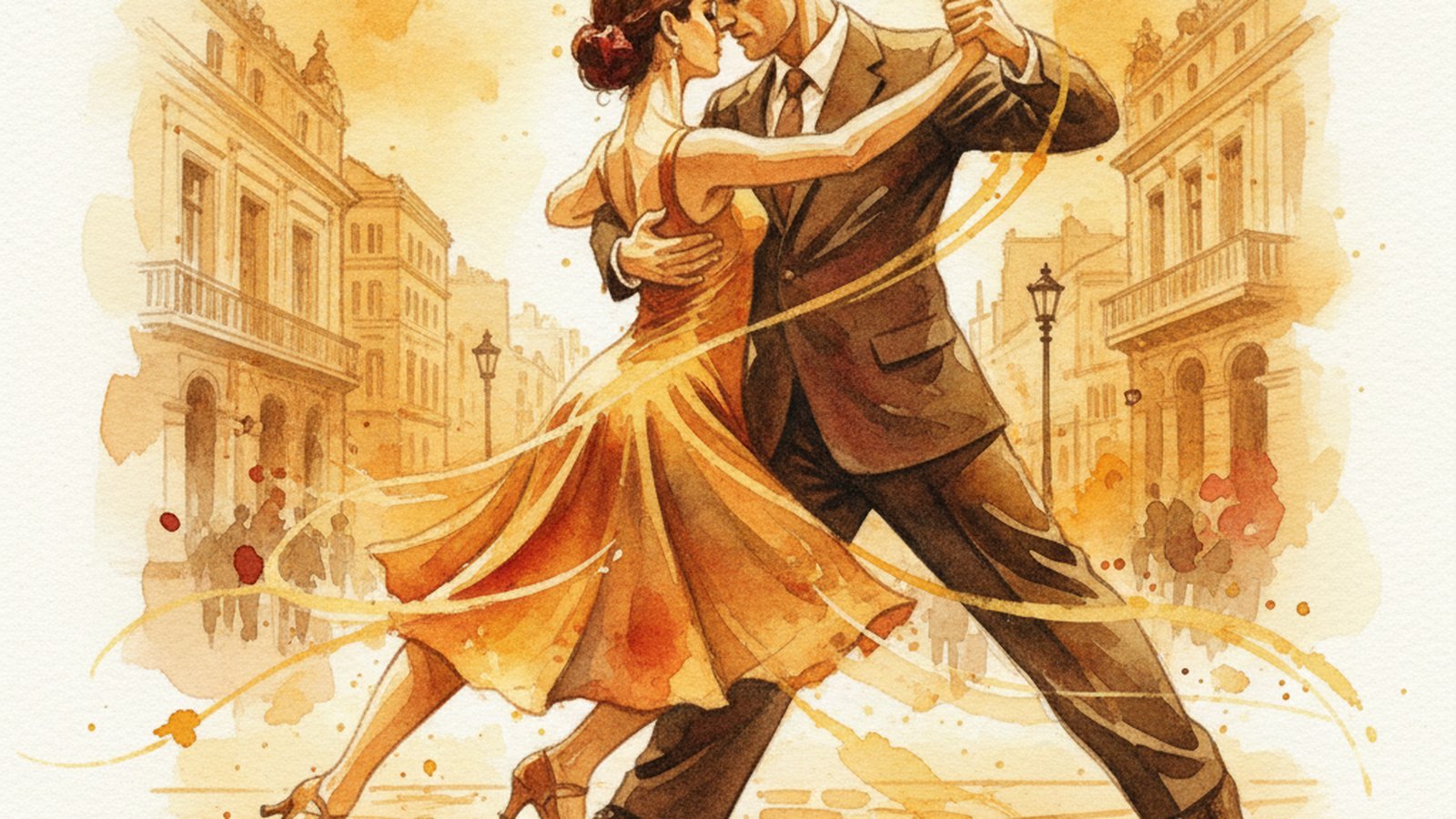
There is a moment, usually about forty seconds into a tanda, when something quietly changes. You stop thinking about the sequence you drilled on Tuesday. The room narrows to the music, the person in your arms, and the small patch of floor in front of you. Whatever happens next, neither of you has planned it — and yet it works.
Ask a room full of London dancers what they love about tango and improvisation almost always comes up, often phrased as something mystical. But improvisation is not mysticism. It is a craft, and it is trainable. More interestingly, it is the same craft that sits underneath every other kind of creative work you do — writing, designing, teaching, cooking, negotiating, parenting. The floor is just an unusually honest place to practise it.
Improvisation is not invention from nothing
The most common misunderstanding among newer dancers is that improvising means making things up out of thin air. It doesn't. Improvisation is recombination under constraint. You have a vocabulary — walking, pivots, changes of direction, pauses, weight changes — and a set of conditions that shift second by second. Creativity is the act of choosing well, quickly, from what you already know.
This is why the experienced dancer at your local milonga who seems to be doing very little is often the most creative person on the floor. They are not running out of ideas; they are running out of reasons to use them. They have learned that a beautifully timed pause is a choice, not an absence of one.
Constraints are the engine, not the obstacle
Every constraint tango places on you is doing creative work on your behalf:
- The music gives you structure — phrase lengths, pauses, a rhythmic spine you didn't have to design.
- Your partner gives you unpredictability. They will not always arrive where you expected, and that is a gift, not an error.
- The ronda gives you a shrinking, moving box that rules out most of your options before you've considered them.
- The floor itself — often a small one, in London — makes half your repertoire impossible tonight.
Anyone who has tried to write with a blank page and infinite freedom knows how paralysing pure openness is. Tango never gives you a blank page. It gives you a page with most of it already filled in, and asks what you'll do with the corner that's left. That's a far more productive creative problem.
What the floor is actually training
Neuroscientists who have put jazz musicians into brain scanners noticed that improvising seems to quiet the self-monitoring, self-editing regions of the brain while other areas become more active. Dancers recognise the feeling immediately: it's the difference between a tanda you performed and a tanda you inhabited. You cannot get there while the critic is running commentary.
Practically, three habits transfer straight off the dance floor and into the rest of your thinking:
- Prototyping instead of planning. On the floor you cannot draft. You commit to a small idea, feel the response, and adjust mid-sentence. That is exactly how good work gets made everywhere else — small bets, fast feedback, willingness to be wrong cheaply.
- Tolerating ambiguity. There is a half-second in every unexpected moment where you genuinely do not know what comes next. Learning to stay relaxed inside that half-second is a skill, and it is the same skill that lets you sit with a hard problem instead of grabbing the first tidy answer.
- Listening as a source of material. Creativity is usually framed as output. In tango it is overwhelmingly input — hearing the violin line you'd been ignoring, feeling that your partner has offered a different axis than you assumed. The best ideas arrive through the ears and the arms, not the head.
A mistake, in tango, is only a mistake if you abandon it. Held for one more beat and answered, it becomes a decision.
Six ways to practise it this week
Improvisational range doesn't grow by learning more sequences. It grows by putting deliberate pressure on the vocabulary you already have. Try these — most work best at a practica, where the stakes are low and stopping to talk is welcome.
- The one-element tanda. Choose a single element — say, the change of direction — and build an entire tanda around variations of it. Restriction forces invention faster than freedom ever does.
- No repeats. Across four songs, never do the same thing twice. You will run out of comfortable material by song two. Song three is where the learning happens.
- Dance a different instrument. Spend one song following the bandoneón, the next the piano's rhythm, the next the singer. Same orchestra, four completely different dances.
- Dance the gaps, not the plan. For one tanda, let the ronda decide everything. Move only where the floor has genuinely opened. It sounds limiting; it's usually liberating.
- Followers: improvise out loud. Decorations, deliberate delays, choosing when to arrive. Following is not obedience — it is real-time authorship, and the dance gets far more interesting when both people are composing.
- Practise recovery, not perfection. Ask a practica partner to deliberately mis-time a response. Your job is simply to keep the dance whole. This is the single highest-value drill most dancers never do.
Why London's floors are good for this
London dancers sometimes apologise for their scene: the halls are small, the floors are crowded, the rent is brutal, and a milonga can be a church hall in Islington one week and a room above a pub in Hackney the next. But those conditions are a creative advantage, and dancers who move here from elsewhere often say so.
Crowded floors kill the big, showy vocabulary and reward precision, musicality and timing — the subtler tools. A scene that runs across dozens of small venues means you dance with an unusually wide range of people: dancers trained in Buenos Aires, in Berlin's nuevo-influenced style, in the close-embrace milonguero tradition, plus a steady stream of complete beginners who don't yet know what is supposed to be impossible. Every one of those partners is a different constraint set. Every one of them expands what you can do.
And there's the community dimension, which matters more than technique. Creative risk needs psychological safety. It is much easier to try the thing you're not sure about with someone you've greeted at the door twenty times than with a stranger you'll never see again. This is a strong argument for becoming a regular somewhere rather than sampling everything — familiarity is what buys you permission to experiment.
Take it off the floor
You don't need to make grand claims about tango transforming your life to notice the carryover. Dancers regularly report that after a good milonga they solve problems differently for a day or two: less gripping, more listening, more willing to try the half-formed version and see what comes back. That's not magic. It's a nervous system that has just spent three hours practising real-time creative decision-making with immediate, honest feedback.
The best part is that the practice is indistinguishable from the pleasure. Nobody goes to a milonga to train their divergent thinking. You go because the music is good and the company is better — and the creativity arrives anyway, as a side effect of paying close attention to someone else for the length of a tanda.
So: pick a practica this week and give yourself one constraint. Then pick a milonga and forget all of it. Both halves are the training.
Find your next floor. Browse practicas, classes and milongas happening across London — from beginner-friendly Sunday afternoons to late-night traditional milongas — on TangoLife.london. Whatever your level, there's a room somewhere in this city tonight where someone is waiting to improvise with you.
Related Articles

Tango Vals: How to Dance with Swing and Flow, Not Counting
Vals isn't one-two-three. Learn to step on beat one, add swing with optional steps, and find the continuous, circular flow that makes tango vals feel like flying.
Milonga Lisa vs Con Traspié: Two Ways to Dance One Rhythm
Milonga lisa keeps it smooth; con traspié adds the cheeky syncopation. Here's how to hear, dance, and choose between both on a London floor.
Caminata Musicale: Turn Your Tango Walk Into Music
The caminata is tango's foundation — but with timing, dynamics and phrasing, a simple walk becomes a musical conversation. Here's how to build yours.