Milonga Lisa vs Con Traspié: Two Ways to Dance One Rhythm
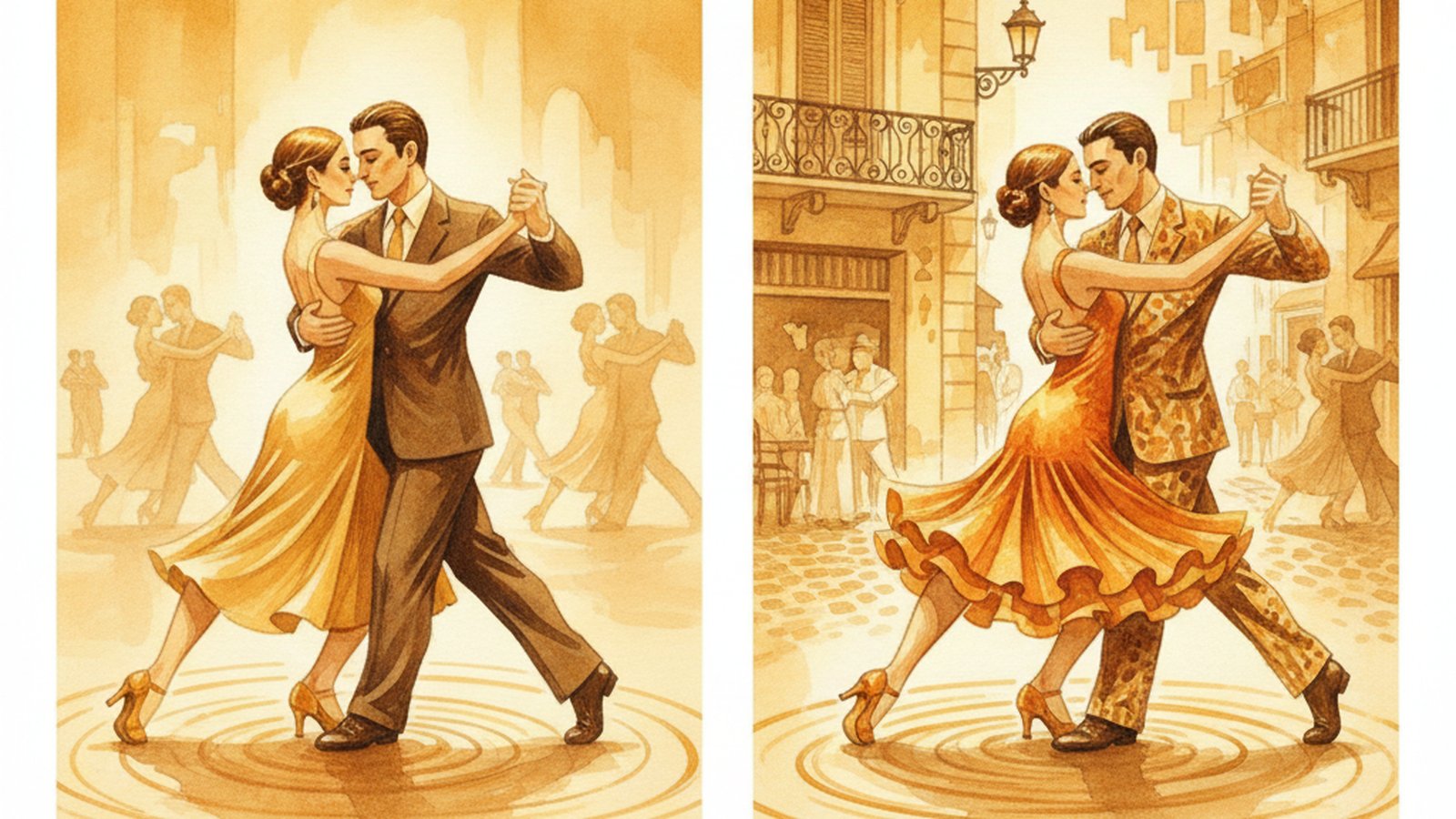
The fastest rhythm in the room, two very different ways to meet it
If you have spent any time at a London milonga, you know the moment the DJ drops a milonga set. The room shifts. Some couples settle into a brisk, even walk that eats up the floor; others suddenly seem to trip, skip and bounce in delicious little double-steps. Same music, same compelling rhythm — and yet two completely different ways of answering it. Those two answers have names: milonga lisa and milonga con traspié.
Understanding the difference is one of the quiet joys of getting deeper into tango. It is also genuinely useful: knowing when to keep it smooth and when to reach for the syncopation will make you a more musical, more considerate, and frankly more fun partner to dance with.
First, what makes milonga milonga?
Before we split it in two, remember what unites it. Milonga is the older, cheekier cousin of tango — faster, more compact, with a steady, insistent pulse that comes from its habanera roots. Where tango can breathe and pause, milonga keeps marching. There is rarely time for a dramatic stop; the music almost always wants you moving forward.
That relentless beat is the canvas. Lisa and con traspié are simply two ways of painting on it.
Milonga lisa: the smooth, walking conversation
The word lisa means smooth or plain, and that is exactly the feel. In milonga lisa you place one step on each strong beat — walk, walk, walk — clean and grounded, with no syncopation. It sounds simple, and that is precisely why it is hard to do beautifully.
Lisa is where milonga is won or lost. With nowhere to hide behind tricks, everything depends on your walk: clear weight changes, a calm upper body, and a connection that lets your partner feel each step coming a fraction before it lands.
- Stay low and compact. Milonga rewards small, quick steps over long, luxurious ones. Think of gliding across the floor rather than reaching for it.
- Keep the chest quiet. The legs do the rhythmic work; the torso stays settled so the lead and follow stay legible at speed.
- Walk with the beat, not after it. Late is the enemy of milonga. Aim to arrive exactly on the pulse, every time.
- Master the basics fast. Walks, simple turns, and the rock step done cleanly will carry you through an entire tanda with grace.
For newer dancers, lisa is the kindest place to start. It teaches you to hear and trust the beat without asking your feet to do anything fancy. Many seasoned London dancers will happily spend a whole milonga tanda in lisa and never feel they are missing out — because a clean, musical walk at speed is its own kind of virtuosity.
Milonga con traspié: catching the off-beat
Then there is traspié — literally a stumble or trip. This is the syncopated, playful milonga that makes onlookers grin. The traspié is a quick extra weight change squeezed in between the main beats, giving you that signature double- or triple-step skip.
If lisa walks on the strong beats (1 and 3, loosely speaking), traspié sneaks a cheeky step onto the and in between. The effect is a stutter, a hesitation, a little rhythmic wink — and then you are back on the beat as if nothing happened.
How to actually find the traspié
Most dancers discover it by accident before they understand it. Here is a way in:
- Walk a simple lisa and feel the steady pulse: step… step… step.
- Add a quick change of weight right before one of those steps — a fast "and-a" — so it becomes step… quick-quick-step.
- Keep it tiny. A traspié is a flick, not a stride. The weight barely travels; it just changes feet.
- Use it sparingly at first. One well-placed traspié per phrase says far more than a constant scramble of them.
The secret of con traspié is restraint. The dancers who look most playful are not doing the most syncopation — they are choosing the perfect moment for it, and then returning to a calm walk.
Con traspié is where milonga earns its reputation for being addictive. It lets you converse with the music's hidden layers — answering a piano flourish or a sly bandoneón accent with a step of your own. But it asks more of your balance, your timing, and your connection, which is why it tends to arrive a little later in a dancer's journey.
Same rhythm, two conversations — not a hierarchy
It is tempting to think of lisa as "beginner" and con traspié as "advanced," but that misses the point. They are not rungs on a ladder; they are vocabulary. The most satisfying milonga dancing weaves between them — long, smooth phrases of lisa that suddenly bloom into a traspié and settle back down again.
Crucially, the choice is also a floorcraft decision. On a packed London floor on a Saturday night, relentless traspié can be a hazard — all those quick changes need space and predictability. Lisa keeps the line of dance flowing and your neighbours safe. Save the fireworks for when the floor genuinely allows it. Reading the room is part of musicality too.
Putting it together on a London floor
- Listen before you move. Spend the first few bars of a milonga tanda simply hearing the pulse. Decide whether the track feels driving (lean into lisa) or bouncy and mischievous (room for traspié).
- Build lisa first. If your walk falls apart at milonga speed, traspié will only amplify the wobble. A solid lisa is the foundation everything else sits on.
- Steal a traspié, don't spam it. One per phrase, landing on a musical accent, will feel ten times more musical than a continuous patter.
- Communicate, don't surprise. A traspié should be felt by your partner a beat early through your chest and intention — never sprung on them.
- Go to milonga-specific practicas and classes. London has a strong tradition of milonga workshops; a single focused session on traspié timing can unlock months of fumbling.
The beautiful truth is that milonga lisa and milonga con traspié are not rivals. They are two halves of the same playful spirit — the smooth and the sly, the steady walk and the cheeky skip. Learn to hear both inside the same song, and you will never run out of things to say when that habanera pulse kicks in.
Find your next milonga in London
The only real way to develop a feel for lisa and traspié is to dance them — often, with different partners, to different DJs. London's milongas serve up everything from gentle, beginner-friendly afternoons to fast, joyful late-night floors where the traspié flows freely.
Browse upcoming milongas, classes, and milonga-focused workshops across the city on TangoLife.london, pick a night, and go find that rhythm for yourself. Your feet — smooth or syncopated — will thank you.
Related Articles

Tango Vals: How to Dance with Swing and Flow, Not Counting
Vals isn't one-two-three. Learn to step on beat one, add swing with optional steps, and find the continuous, circular flow that makes tango vals feel like flying.
Milonga Lisa vs Milonga Con Traspié: Two Rhythmic Approaches
Milonga lisa gives you steady rhythm; milonga con traspié adds playful syncopation. Learn the difference and when to use each for a joyful milonga experience.
Caminata Musicale: Turn Your Tango Walk Into Music
The caminata is tango's foundation — but with timing, dynamics and phrasing, a simple walk becomes a musical conversation. Here's how to build yours.