Tango DJ Confidence: Beating Milonga Imposter Syndrome
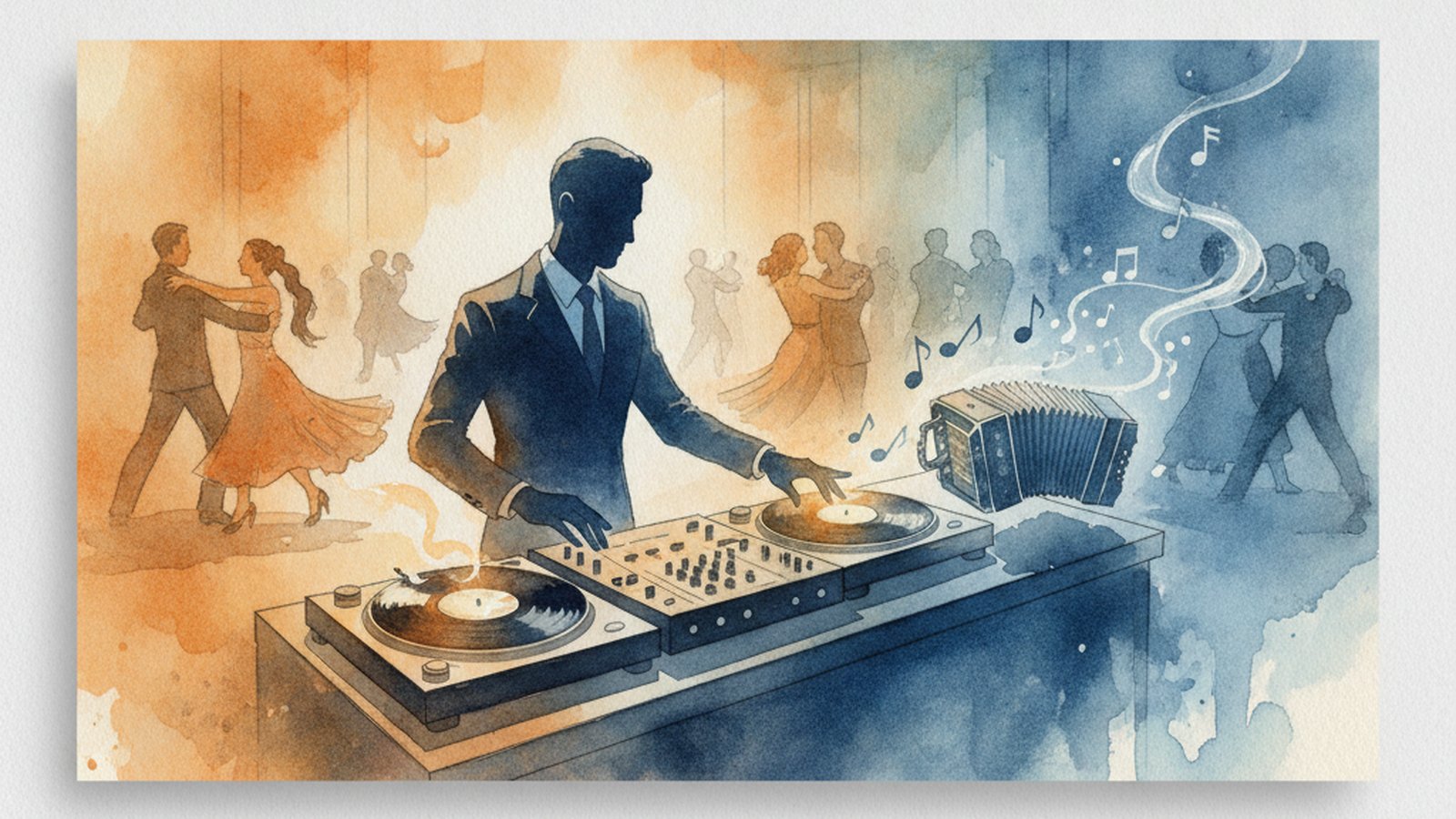
The Fear Behind the Laptop
Every tango DJ remembers the first time they faded a cortina into silence and felt the whole room turn toward the booth. Your hand hovers over the trackpad. A couple sits down mid-tanda. Did you misjudge the energy? Is that dancer frowning at your Pugliese, or at their own balance? Welcome to imposter syndrome — the quiet conviction that everyone in the room knows this music better than you do.
Here is the truth experienced DJs rarely say out loud: that feeling never fully disappears, and it shouldn’t. The DJs worth dancing to are the ones who still care whether the floor is happy. What changes is your relationship to the fear. Let’s turn it from a paralysing voice into a craft you can practise.
You Are a Curator, Not a Performer
The first reframe is the most important one. You are not on stage. Nobody came to watch you. They came to dance with each other, and your job is to give them the floor on which to do it. A milonga DJ is closer to a thoughtful host than a virtuoso — you read the room, you pour the right thing at the right moment, and you stay invisible when things are going well.
This is liberating, because it means a “perfect” set does not exist, and perfect was never the goal. A generous set is the goal: music that makes ordinary dancers feel like better dancers than they are.
Let the Music Do the Heavy Lifting
Confidence grows from knowledge, and in tango the knowledge is the recordings. You do not need ten thousand tracks. You need to know a few hundred deeply. Start with the pillars of the Golden Age and learn what each orchestra feels like under the feet:
- Juan D’Arienzo — the metronome. Driving, rhythmic, impossible to sit still to. Your floor-filler when energy dips.
- Carlos Di Sarli — elegant, legato, oceanic. The strings carry the walk. Perfect for a refined, flowing tanda.
- Aníbal Troilo — the most balanced of all, rhythm and lyricism in one hand. When in doubt, Troilo rarely fails.
- Osvaldo Pugliese — dramatic, elastic, heavy. Powerful late at night for experienced dancers; risky early.
- Miguel Caló, Ricardo Tanturi, Rodolfo Biagi — the “second tier” that working DJs lean on constantly.
When you can hear the difference between Di Sarli’s Bahía Blanca and D’Arienzo’s El Flete with your eyes closed, you stop guessing and start choosing. That is where confidence lives.
The Tanda Is Your Sentence
Beginners obsess over individual tracks. Experienced DJs think in tandas — sets of three or four songs that belong together. A tanda is a small emotional argument with a beginning, a middle, and a resolution, bookended by a cortina that clears the floor. Three principles will carry you a long way:
- One orchestra, one era. Don’t mix 1940s Di Sarli with his 1950s recordings in the same tanda; the sound and tempo shift too much. Cohesion is comfort.
- Don’t mix instrumental and vocal. Keep a tanda all instrumental or build it around a single singer. A Tanturi tanda with Alberto Castillo has a completely different colour than one with Enrique Campos.
- Open strong, peak in the middle. Lead with an inviting track, place your most beautiful song second or third, and end on something that leaves dancers wanting the next tanda.
The classic milonga arc — tango, tango, vals, tango, tango, milonga — gives the night its breathing pattern. Respect it before you break it.
Own the Sound System Before the First Cortina
Nothing rattles a new DJ faster than a technical fumble in front of a full room. Most of that anxiety is preventable with thirty minutes of preparation:
- Arrive early and test the actual room, not your headphones. Golden Age recordings are mono and bright; roll off a little high end so the hiss doesn’t fatigue ears over four hours.
- Normalise your levels. Transfers vary wildly in loudness. Use ReplayGain or manual gain so dancers never lurch from a whisper-quiet Canaro into a blaring D’Arienzo.
- Set a comfortable baseline volume — loud enough to feel the beat in the floor, quiet enough that a couple can talk between songs. Then leave it alone.
- Always carry a backup. A second device, an offline copy of your library, and a cable you know works. Redundancy is confidence.
Reading the Floor
This is the skill that feels like magic and is really just attention. Look up from the screen. Are people dancing close and slow, or travelling fast? Is the floor full, or are couples drifting to their seats? A thinning floor is not a verdict on your taste — people may simply be tired, and a gentle Canaro or a playful milonga can revive them better than a heavier Pugliese.
The floor is always talking to you. Imposter syndrome is what happens when you stop listening to the room and start listening to the critic in your head.
Trust patterns over single reactions. One person sitting down means nothing. Half the floor sitting down means change course. And when a tanda truly lands — when the room sighs into the music together — let yourself feel it. That, too, is data.
Recommended Tandas
Here are two reliable, floor-tested tandas to anchor your early sets — one flowing and elegant, one rhythmic and energising.
Tanda 1 — Carlos Di Sarli (Instrumental, Mid-1940s)
Elegant, legato, endlessly danceable. A safe and beautiful choice for almost any moment of the night.
- El jagüel — Carlos Di Sarli (instrumental) — 1944
- A la gran muñeca — Carlos Di Sarli (instrumental) — 1945
- Germaine — Carlos Di Sarli (instrumental) — 1945
Tanda 2 — Juan D’Arienzo with Alberto Echagüe (Late 1930s)
Driving rhythm and a singer with grit. Reach for this when the energy needs a lift.
- Paciencia — Juan D’Arienzo, vocal Alberto Echagüe — 1937
- Nada más — Juan D’Arienzo, vocal Alberto Echagüe — 1938
- Pensálo bien — Juan D’Arienzo, vocal Alberto Echagüe — 1938
You Belong in the Booth
So here is your permission slip: you are ready enough. The only way to become a confident tango DJ is to DJ — to make small, careful choices in front of real dancers and learn from the floor in front of you. Start at the practicas and smaller milongas, offer to cover a tanda or two, and grow from there.
Looking for a room to listen in, learn in, or play in? Explore upcoming milongas, practicas, and festivals on TangoLife.london — and find the event where your first set is waiting.
Related Articles
Travelling as a Tango DJ: Spinning Milongas Across Cultures
What changes when you DJ a milonga in a city you've never danced in? Practical craft on reading unfamiliar floors, taming borrowed sound systems, and building tandas that travel anywhere.

The Tango DJ Spectrum: From Purist to Eclectic
Purist, traditionalist or eclectic — the label matters far less than the floor. A working guide to repertoire, tanda construction, sound and reading a room, with two complete tandas.

Traditional vs Progressive Tango DJing: Find Your Style
Traditional and progressive tango DJing are less opposed than they look. A working guide to tanda construction, sound levels, reading the ronda, and finding your own voice.