Travelling as a Tango DJ: Spinning Milongas Across Cultures
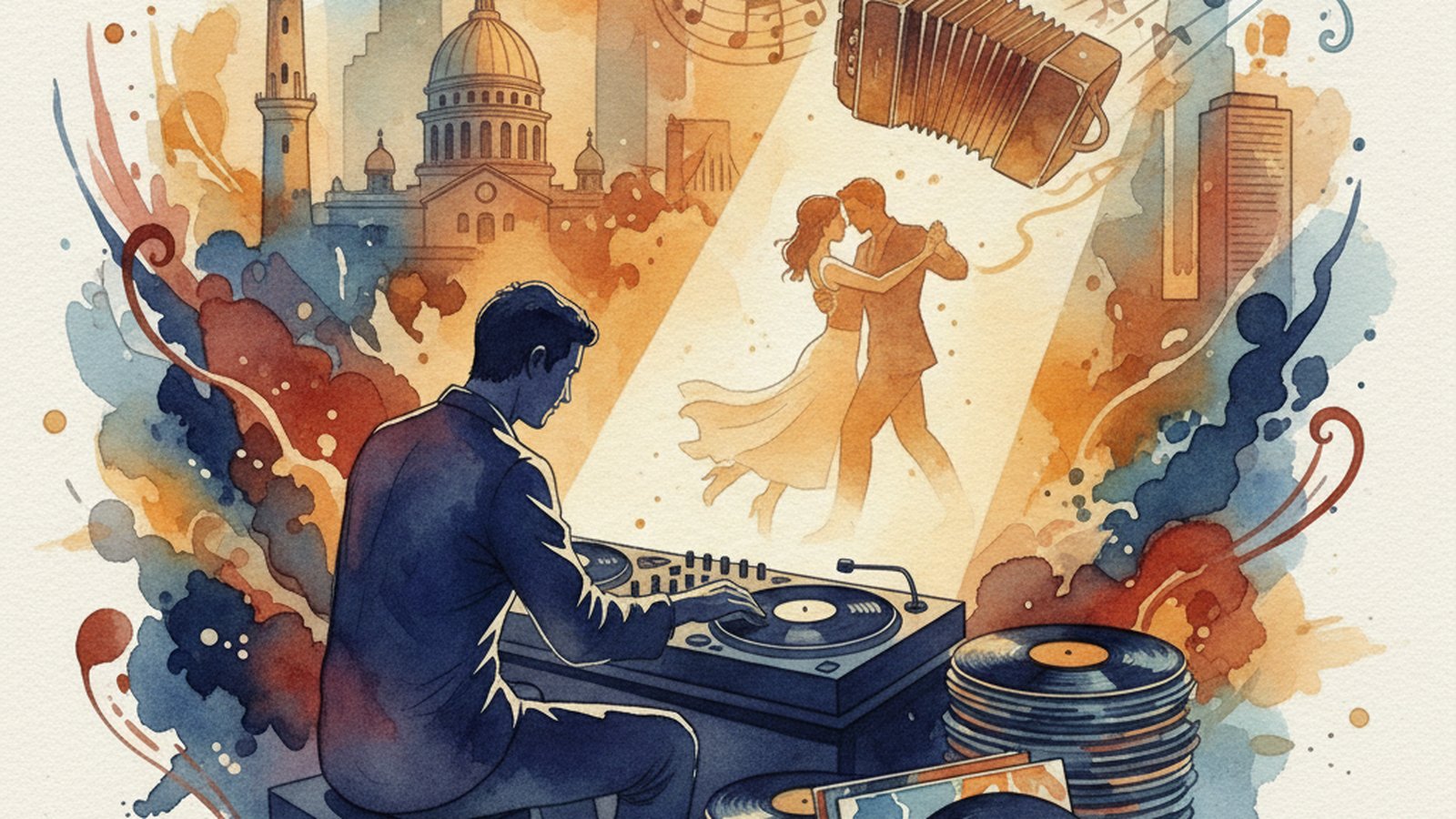
The first time I DJed a milonga in a city where I knew no one, I made every mistake at once. I opened with a brooding Pugliese tanda because it was the music I loved that week, watched the floor stay stubbornly empty, and learned in real time that a travelling DJ does not bring their taste — they bring their ears. Packing a hard drive is the easy part. The craft is arriving as a stranger and, within forty minutes, sounding like you have run that room for years.
Whether you are flying to a marathon in Istanbul, covering a friend's milonga in Berlin, or guesting at a practica in your own city's unfamiliar corner, the principles are the same. Here is what I wish someone had told me before my passport filled up with tango stamps.
Your library is your passport — so curate it like one
You cannot carry everything, and you should not try. I travel with a tightly organised core of the golden-age pillars and trust them to cover almost any room: D'Arienzo for rhythm and rescue, Di Sarli for elegance, Troilo for warmth and emotional depth, Pugliese for the dramatic peak, plus Caló, Tanturi, Biagi, Donato and D'Agostino–Vargas to colour everything in between.
The mistake is bringing only your favourites. Bring the functional repertoire — the music that gets specific jobs done. You want a remastered, clean transfer of each recording too; a tinny third-generation rip that sounds fine on your headphones at home will fall apart through a strange PA in a tiled room. Sound quality is not vanity. It is the difference between dancers closing their eyes and dancers wincing.
Read the room before you read the music
Every tango community has a dialect. The same tanda lands differently in Buenos Aires, Helsinki, Seoul and a London basement. Before I play a single note, I try to spend twenty minutes simply watching — and if I cannot, I ask the organiser three questions: What's the average dancing level? How long are the embraces — close all night, or open and playful? And what do they hate? That last question saves careers.
You are not there to educate the floor about your taste. You are there to give the dancers the night they came for, told in your accent.
Some cultures are deeply traditional and expect strict golden-age tandas with clean cortinas and the cabeceo respected by your lighting and volume. Others happily fold in nuevo or alternative sets. Reading this wrong is the fastest way to clear a floor. When in doubt, start traditional and rhythmic — a confident D'Arienzo or early Tanturi tanda is understood everywhere on earth.
Watch feet, not faces
The floor tells you the truth. If couples are crowding the centre and barely moving, they want lyrical, grounded music — lean into Di Sarli and Caló. If the ronda is flowing fast and energy is rising, feed it with Biagi or D'Arienzo. When you see people sitting down mid-tanda, you have misjudged the energy; do not panic, just make your next cortina decisive and reset.
Tanda construction on the road
Four tangos, three valses, three or four milongas — that structure is a near-universal language, and honouring it earns instant trust from a room that has never seen you. The deeper craft is the arc of the night. Open gently to let bodies warm up and latecomers arrive. Build energy in waves rather than a straight line — every rhythmic peak needs a lyrical recovery before the next climb. Save Pugliese's La Yumba or Gallo Ciego for a moment the floor has truly earned, usually late, when the best dancers are warm and the room wants to be moved.
- Keep each tanda cohesive: same orchestra, same era, same singer (or all instrumental). A 1939 Di Sarli instrumental and a 1955 Di Sarli with Rufino belong in different tandas.
- Mind your cortinas: roughly thirty seconds of clearly non-tango music, the same family of cortina all night so the room learns your signal. In traditional crowds, never let a cortina tempt people to keep dancing.
- Have escape tandas ready: two or three bulletproof, universally loved sets you can deploy when the energy dips and you need to win the room back instantly.
The sound system you did not choose
At home you know your gear. On the road you inherit whatever the venue has — a wedding-hall PA, a pair of tired speakers in opposite corners, a mixer with a mystery EQ curve. Arrive early. Always. An hour before the first dancers is not generous; it is the minimum.
- Carry your own adapters and a backup interface. A small USB audio interface, a set of jack and RCA adapters, and a spare cable have saved more of my nights than any clever playlist.
- Set levels with the room empty, then trim down. A full room of bodies absorbs high frequencies; what sounds crisp in an empty hall turns muddy once forty couples are dancing. Leave headroom and resist the urge to chase the loss with volume.
- Tame the room, not just the track. Tiled or glass rooms scream in the high mids — gently pull them back. Carpeted basements eat the bass — add a touch, sparingly. Golden-age recordings are mono; do not let one speaker dominate one side of the floor.
- Protect against silence. A dead laptop battery mid-milonga is unforgivable. Stay on mains power, keep a charged phone with a backup set, and never trust the venue Wi-Fi for streaming. Your music lives offline.
Respect, humility and the long game
You are a guest in someone else's tradition. Learn the local resident DJs' names and listen to them. Honour the organiser's wishes even when they differ from your instinct — it is their community, their reputation, their floor. Travelling DJs who treat each city as a chance to learn a new dialect get invited back; those who arrive to lecture do not. The milonga is a conversation, and you are only one voice in it.
Recommended Tandas
Two reliable sets I carry to every city — one to settle and elevate a room, one to lift it off the floor when the energy needs rescuing.
Tanda 1 — Carlos Di Sarli, instrumental (the elegant settler)
- A la gran muñeca — Carlos Di Sarli, instrumental (1954)
- Bahía Blanca — Carlos Di Sarli, instrumental (1957)
- Champagne Tango — Carlos Di Sarli, instrumental (1957)
- Indio Manso — Carlos Di Sarli, instrumental (1958)
Why it travels: grand, grounded and universally beloved. The spacious phrasing invites long, walking embraces and works for mixed-level floors anywhere in the world.
Tanda 2 — Juan D'Arienzo with Alberto Echagüe (the floor-rescuer)
- Paciencia — Juan D'Arienzo, vocal Alberto Echagüe (1937)
- Nada más — Juan D'Arienzo, vocal Alberto Echagüe (1938)
- Pensalo bien — Juan D'Arienzo, vocal Alberto Echagüe (1938)
- Mandria — Juan D'Arienzo, vocal Alberto Echagüe (1939)
Why it travels: unmistakable driving rhythm and theatrical vocals that pull hesitant dancers back onto the floor. When a room has gone quiet, this is the tanda that wakes it up.
Bring your ears to the next city
The best travelling tango DJs are not the ones with the rarest recordings — they are the ones who listen hardest. Pack light, arrive early, respect the room, and let the dancers tell you who they are. Wherever your next milonga is, may the floor be full and the cortinas land clean.
Planning your tango travels? Explore upcoming milongas, marathons and events — and connect with organisers and DJs across the scene — at TangoLife.london. Find your next floor.
Related Articles
Tango DJ Confidence: Beating Milonga Imposter Syndrome
Imposter syndrome haunts almost every new tango DJ. Here is how to reframe the fear, build tandas dancers trust, and find the confidence to own the booth.

The Tango DJ Spectrum: From Purist to Eclectic
Purist, traditionalist or eclectic — the label matters far less than the floor. A working guide to repertoire, tanda construction, sound and reading a room, with two complete tandas.

Traditional vs Progressive Tango DJing: Find Your Style
Traditional and progressive tango DJing are less opposed than they look. A working guide to tanda construction, sound levels, reading the ronda, and finding your own voice.