The thankless job: why tango DJing is a labour of love
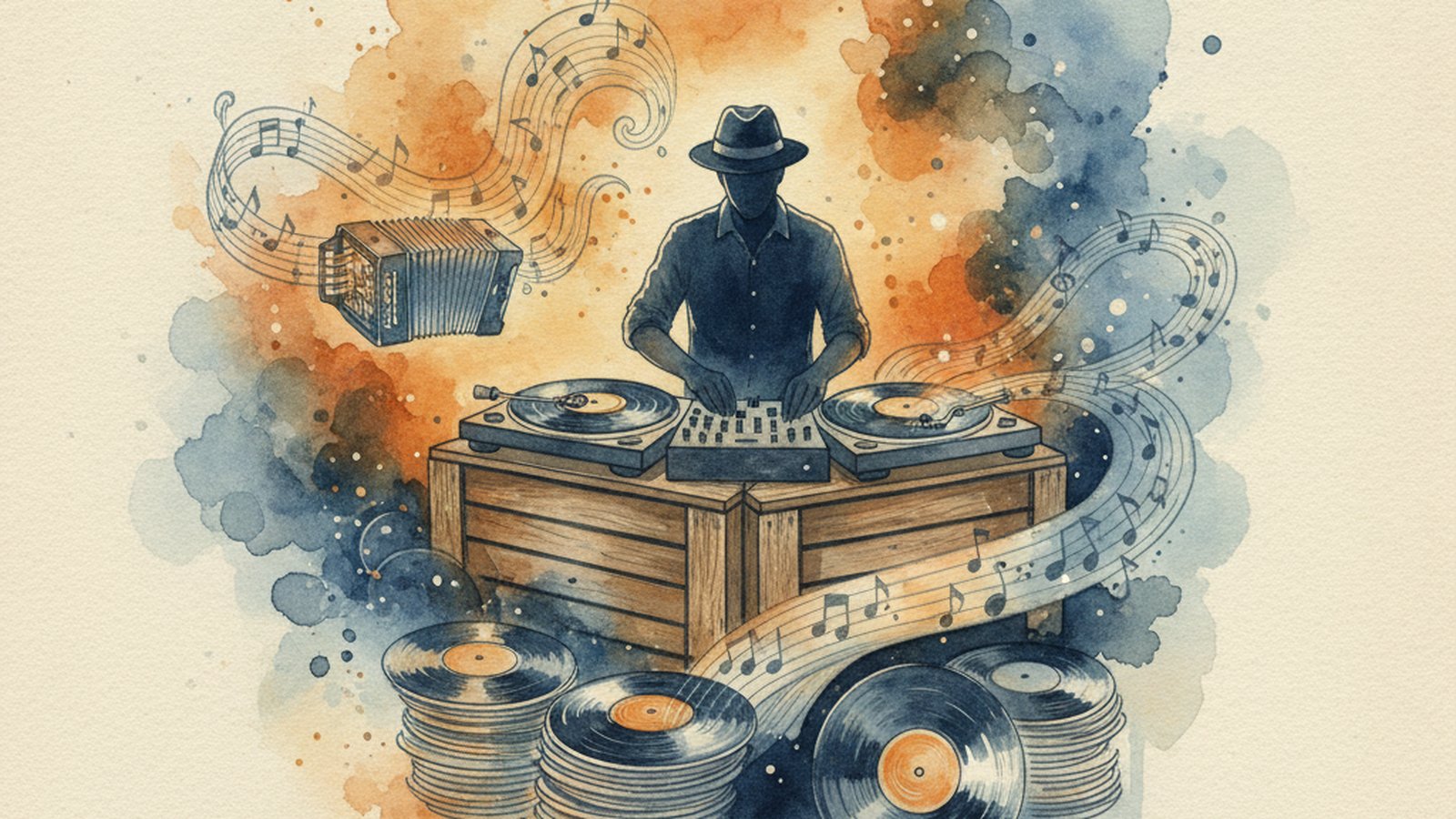
The job nobody applauds
Here is the strange truth about musicalizar a milonga: when you do it perfectly, no one notices you at all. The floor fills, the energy lifts, couples lose track of time, and at the end of the night someone thanks the organiser for a wonderful evening. The DJ packs up the laptop in the dark. That is the deal. A great tango DJ is invisible, and learning to love that invisibility is the first lesson of the craft.
We do this for the same reason the dancers come: the music. Nobody builds a 1,200-track library of pristine transfers, learns to tell a 1939 D'Arienzo from a 1944 one by ear, and hauls a sound rig across London on a wet Tuesday for the glory. We do it because a well-judged tanda at the right moment can make a room feel like it is breathing together. If that sounds like you, read on. This is one DJ talking to another about the part of the work that never makes it onto the flyer.
It starts with the music, not the playlist
Your job is not to play songs you love. It is to play music people can dance to, in the language their bodies already speak. That means living inside the Golden Age (roughly 1935 to 1955) until its dialects are second nature. Learn the four cornerstones first: the relentless, marcato drive of Juan D'Arienzo, the smooth legato and unmistakable bass of Carlos Di Sarli, the lyrical sophistication of Aníbal Troilo, and the dramatic, rubato architecture of Osvaldo Pugliese. Around them sit the colours: the romantic Miguel Caló, the playful staccato of Rodolfo Biagi, the rustic charm of Edgardo Donato, and the elegant Ángel D'Agostino with Ángel Vargas.
Sound quality is not optional. A muddy, over-compressed transfer of Bahía Blanca robs Di Sarli of the very bass that makes dancers feel the ground. Invest in good transfers from reputable labels and curators, normalise your library so tandas do not lurch in volume, and listen on the gear you will actually play on, not your studio headphones.
The tanda is your sentence, the cortina your full stop
Dancers do not experience songs. They experience tandas — sets of three or four tracks that share an orchestra, an era, and a mood — separated by a cortina, a short burst of non-tango music that clears the floor and resets the embrace. The cortina is doing quiet, serious work: it gives people permission to change partners. Keep it 20 to 30 seconds, consistent across the night, and emphatically not danceable.
Building a tanda is composition, not shuffling. A few rules that have saved me many times:
- One orchestra, one era. Four tracks from the same orchestra within a few years sit together rhythmically. Mixing 1939 D'Arienzo with 1951 D'Arienzo can break a dancer's timing mid-tanda.
- Four tangos, three valses, three milongas. Valses and milongas are more intense, so a shorter set respects tired legs.
- Open accessible, build subtly. Lead with the clearest, most inviting track so couples commit during the first song, then deepen.
- Vocals tell a story. An instrumental-then-vocal arc, or a tanda built around one singer like Roberto Rufino or Alberto Podestá, gives emotional shape.
The macro-structure matters too. The classic rotation is two tango tandas, a vals, two more tango tandas, then a milonga (T-T-V-T-T-M), repeated. It is a rhythm dancers feel even when they cannot name it. Break it occasionally for effect; abandon it and the room gets restless.
Sound is half the dance
You can have flawless taste and still ruin a milonga with bad sound. Tango is danced in close embrace, and dancers navigate as much by the bass and the room as by counting. Practical setup wisdom:
- Aim for even coverage, not volume. A couple at the far corner should hear the beat as clearly as the couple under the speakers. Two smaller speakers well-placed beat one loud one.
- Protect the low end. The marcato pulse lives in the bass. A tinny PA makes D'Arienzo sound like a toy. Check it before doors open by walking the floor while a track plays.
- Watch the room as it fills. Bodies absorb sound; a level that was perfect at 8pm will feel thin by 10pm. Nudge it up gently as the floor fills.
- Carry redundancy. A spare cable, a backup audio source, and a second copy of your library have rescued more nights than talent ever has.
Reading the floor
This is the skill that separates a DJ from a jukebox, and it cannot be automated. Look up from the screen. Are couples dancing or drifting to the edges? Is the embrace open and chatty, or close and absorbed? A floor that empties after the first song of a tanda is telling you the energy was wrong; a floor that stays packed through a vals is begging you to keep the lift going.
Play for the dancers in the room tonight, not the ideal dancers in your head.
A room of beginners needs steady, clear rhythm — early D'Arienzo, simple Donato — not a moody, rubato-heavy Pugliese tanda that leaves them stranded off the beat. A floor of experienced milongueros will reward you for Troilo's subtleties and a late-night Pugliese set built around La Yumba. Watch, adjust, and never punish the dancers for your own ambition.
The arc of an evening
A milonga has a shape: a gentle, welcoming opening while people arrive and warm up, a confident middle where you take risks and lift the energy, a peak somewhere in the back half, and a tender wind-down toward the last tanda. Save your most emotional cards — a transcendent Di Sarli vals, a Pugliese tanda that makes people hold their partner a little tighter — for when the room has earned them. End with La Cumparsita; everyone knows the night is over, and they will thank the organiser, and you will smile and start coiling cables.
Recommended Tandas
Two reliable, floor-tested sets to study or steal. Note the deliberate four-track tango set and three-track vals set.
Tanda 1 — Carlos Di Sarli, instrumental (early 1940s): smooth, grounded, universally danceable
- El Recodo — Carlos Di Sarli (instrumental), 1941
- Racing Club — Carlos Di Sarli (instrumental), 1942
- El Pollo Ricardo — Carlos Di Sarli (instrumental), 1942
- A la Gran Muñeca — Carlos Di Sarli (instrumental), 1945
Tanda 2 — Juan D'Arienzo, valses: bright, lifting, a guaranteed crowd-pleaser
- Pabellón de las Rosas — Juan D'Arienzo (instrumental), 1941
- Valsecito de Antes — Juan D'Arienzo, vocal Alberto Echagüe, 1942
- Lágrimas y Sonrisas — Juan D'Arienzo (instrumental), 1942
The reward is real, even if it is quiet
The applause may go elsewhere, but the satisfaction is yours alone: the moment a floor exhales into a vals you placed exactly right, the regular who catches your eye and nods because they know it was you. That is the labour, and that is the love. If you want to hear great DJs at work, study the rotation in person, or find a milonga to dance and listen at, explore the events on TangoLife.london — and if you are the one behind the laptop, come share the craft with the rest of us.
Related Articles

The Tango DJ Spectrum: From Purist to Eclectic
Purist, traditionalist or eclectic — the label matters far less than the floor. A working guide to repertoire, tanda construction, sound and reading a room, with two complete tandas.
Musical Storytelling: Building a Narrative Arc With Tandas
A playlist fills four hours; an arc makes a night people remember. How to build tandas that speak to each other, shape a milonga in four acts, and read the floor as you go.

Adapting Your Tango DJ Style for Milongas Around the World
The same record collection lands differently in Buenos Aires, Berlin and London. Here's how to read a tango community and adapt your milonga sets without losing your voice as a DJ.