The Ego Trap: Staying Humble When DJing Becomes Your Identity
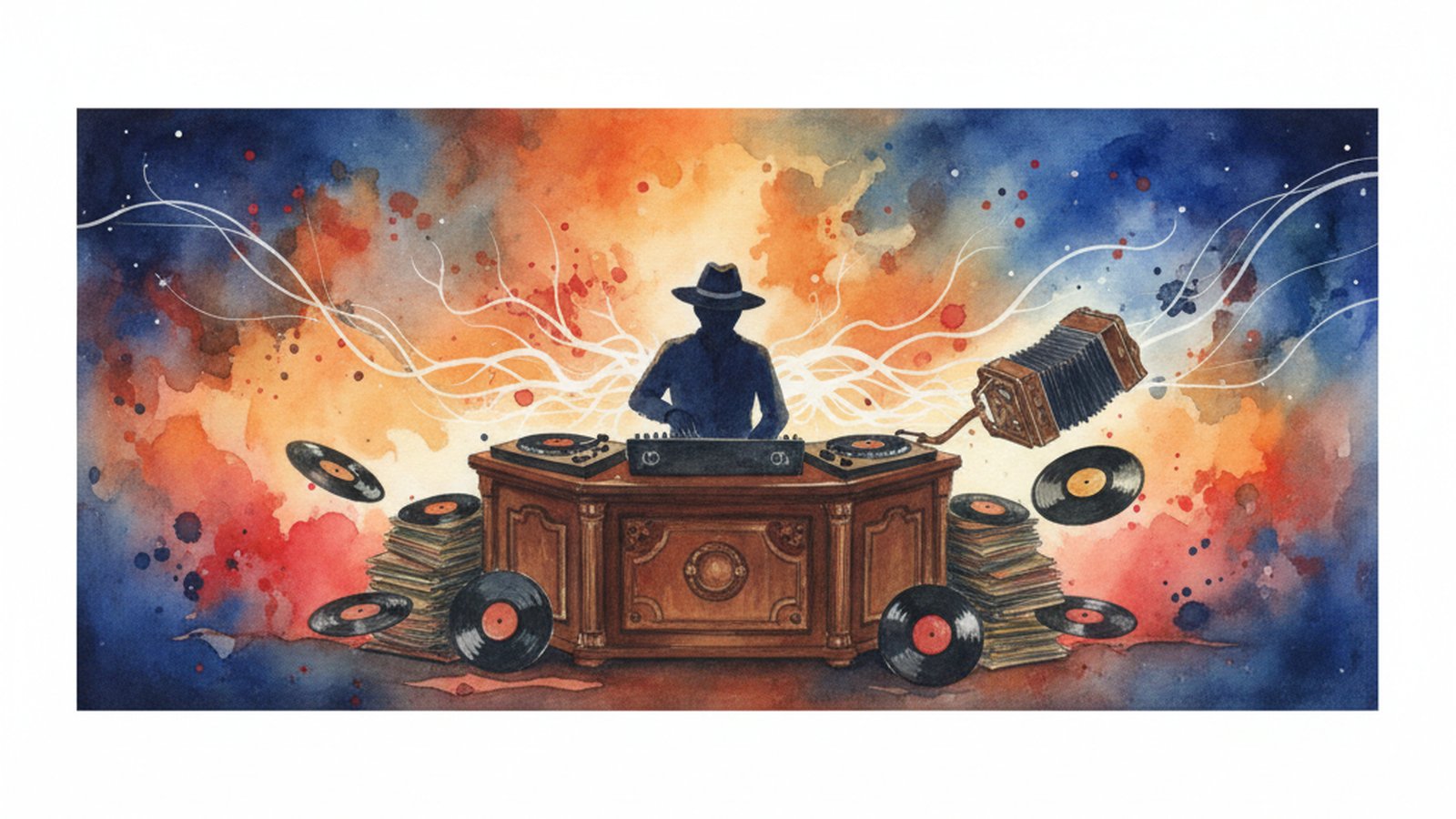
The night the floor went quiet
Every tango DJ has a version of this story. You build a set you are proud of, something clever, something that shows how deep your collection runs. The cabeceos slow. The floor thins. A couple sits down mid-tanda. And instead of asking what the room needed, your first thought is: they do not get it. That thought is the ego trap, and the longer you DJ, the more cunning it becomes.
When DJing becomes part of who you are rather than something you do, every empty floor feels like a personal verdict. That is dangerous, because the moment your self-worth is riding on the music, you stop serving dancers and start auditioning for them. This article is about catching that drift early and building habits that keep your ego in the bag where it belongs.
The booth is a mirror, and that is the problem
A milonga puts you at the front of the room with a glowing screen and, often, a microphone. People thank you. Organisers introduce you by name. It is intoxicating, and it quietly rewires how you hear the music. You start choosing tracks that make you look knowledgeable rather than tracks that make the dancers feel good.
The tell is always the same: you reach for the rare over the right. A pristine instrumental Di Sarli from 1955 will fill a floor; a scratchy 1928 Fresedo curio will earn you a knowing nod from two collectors and empty the rest of the room. Both are good music. Only one is good DJing. Humility, in practical terms, is the discipline of choosing the second-most-impressive option because it is the most danceable one.
You are not curating a museum. You are running a dance floor. The dancers are the art; you are the lighting.
Reading the floor is humility made visible
The single best antidote to ego is to watch the floor more than you watch your screen. The dancers are giving you continuous, honest feedback, and it costs you nothing to listen.
- Embrace height. When couples are dancing close and slow, they are asking for melody and warmth, think Carlos Di Sarli or Aníbal Troilo. When the embrace opens up and feet get busy, they want rhythm, that is your D'Arienzo and early Biagi territory.
- The tanda exit. Watch what happens in the cortina. If most couples stay together for the next tanda, you read the energy correctly. If half the floor clears, you misjudged it. Adjust the next set, do not double down to prove a point.
- The back third. Beginners and social dancers sit toward the edges. If only the front-and-centre experts are dancing, your selection has drifted too obscure. A healthy floor includes the people who just want a clear, steady beat.
None of this requires you to abandon taste. It requires you to put taste in service of the room rather than in front of it.
Tanda construction: where craft beats showing off
The tanda is where ego does its quietest damage. A well-built tanda has a single emotional thesis, one orchestra, one era, one mood, so dancers can settle into it after the first two bars. Ego-driven tandas, by contrast, try to cram three clever ideas into four songs and leave dancers re-calibrating every time the music changes.
Some working principles:
- Coherence first. Keep one orchestra and a tight window of years. A Troilo tanda from 1941 holds together; Troilo 1941 next to Troilo 1955 does not, the sound, tempo, and vocalist all shifted.
- Open easy, peak in the middle. Lead with an accessible track, place your strongest song third, and close with something that resolves rather than escalates. Dancers should leave the tanda satisfied, not exhausted.
- Respect the rhythm of the night. The classic D'Arienzo to Di Sarli to Troilo to Pugliese arc exists because it works. Pugliese late, when dancers are warm and the floor is forgiving, never as your second tanda when bodies are cold.
- Cortinas are punctuation. Keep them short, non-tango, and consistent. The cortina is not your chance to show off your taste in jazz or pop; it is a clear signal that one tanda has ended and dancers may change partners.
Sound is service, not spectacle
Nothing exposes an ego faster than a DJ who treats the volume knob as a personal instrument. Loud does not mean good. The goal is for a couple in the far corner to hear the bandoneón clearly while still being able to murmur to each other.
- Arrive early and walk the room. Sound behaves differently on an empty floor than a packed one; bodies absorb high frequencies. Set your baseline before doors, then trim the treble slightly as the room fills.
- Tame the bass. Old recordings have uneven low end. A gentle high-pass filter around 60 to 80 Hz cleans up rumble without thinning the orchestra. Resist the urge to boost bass to feel powerful, it muddies the rhythm dancers rely on.
- Normalise your levels. A 1930s D'Arienzo and a 1950s Di Sarli were mastered decades apart. Match perceived loudness across tandas so dancers are never jolted. Inconsistent levels read as carelessness, not character.
- Carry redundancy. A spare cable, a backup device, an offline copy of your library. The humble DJ plans for failure quietly; the ego-driven one improvises loudly and blames the venue.
Practical habits that keep ego in check
Humility is not a personality trait, it is a set of repeatable habits:
- Ask the organiser who is coming and what the crowd likes before you build a single tanda.
- Keep a private log of which tandas filled the floor and which emptied it. Data is humbling in the best way.
- When a respected dancer requests something, treat it as floor intelligence, not a challenge to your authority.
- Play the warhorses without shame. La cumparsita closes the night because it works, not because it is original.
Recommended Tandas
Two contrasting tandas, one to lift the room, one to deepen it. Both are crowd-tested and easy to read.
Tanda 1, Rhythmic opener, Juan D'Arienzo (instrumental, 1935 to 1937)
- Nueve de Julio, Juan D'Arienzo, instrumental, 1935
- Hotel Victoria, Juan D'Arienzo, instrumental, 1935
- El flete, Juan D'Arienzo, instrumental, 1936
- El irresistible, Juan D'Arienzo, instrumental, 1937
This is your wake-the-floor set, the driving Biagi-era piano and that relentless marcato pull beginners and veterans up together. Perfect early or whenever the energy sags.
Tanda 2, Emotional depth, Aníbal Troilo with Francisco Fiorentino (1941 to 1942)
- Toda mi vida, Aníbal Troilo, vocal Francisco Fiorentino, 1941
- En esta tarde gris, Aníbal Troilo, vocal Francisco Fiorentino, 1941
- Malena, Aníbal Troilo, vocal Francisco Fiorentino, 1942
- Pa' que bailen los muchachos, Aníbal Troilo, vocal Francisco Fiorentino, 1942
Save this for later in the night, when the embrace has closed and dancers want to feel something. Fiorentino's warmth over Troilo's bandoneón rewards a room that is ready to listen, not one you are trying to impress.
The work is the reward
The best tango DJs I know are almost invisible. You remember the night, the embrace, the floor that never emptied, and only later realise someone built all of it, tanda by tanda, without ever needing you to notice them. That is the craft. Keep your name off the music and your attention on the dancers, and the ego trap loses its grip.
If you want to put these ideas into practice, get out from behind the screen and onto the floor as a dancer first. Explore upcoming milongas, practicas, and DJ-led events near you on TangoLife.london, listen to how the best DJs in the city read a room, and bring what you learn back to your own booth.
Related Articles
The thankless job: why tango DJing is a labour of love
Tango DJs work in the shadows, thanked by no one yet shaping the whole night. A working DJ shares craft wisdom on music, tandas, sound, and reading the floor.

The Tango DJ Spectrum: From Purist to Eclectic
Purist, traditionalist or eclectic — the label matters far less than the floor. A working guide to repertoire, tanda construction, sound and reading a room, with two complete tandas.

Traditional vs Progressive Tango DJing: Find Your Style
Traditional and progressive tango DJing are less opposed than they look. A working guide to tanda construction, sound levels, reading the ronda, and finding your own voice.